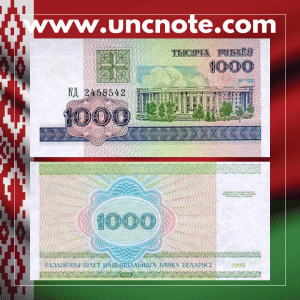
Issued by the National Bank of Belarus in 1998 as part of the late 1990s currency series, this 1000 Rubles banknote features the Mir Castle Complex, a UNESCO World Heritage Site, on the obverse. The castle is shown in detailed engraving with a color palette of brown and green.
The reverse side depicts the Pahonia coat of arms, illustrating a mounted knight with sword and shield, set against intricate ornamental designs. Printed on 100% cotton paper, the banknote includes a watermark of the Mir Castle, a security thread, and red UV-fluorescent fibers.
The note measures 150 x 69 mm and remained in circulation until the currency reform of 2000.
Obverse
National Academy of Sciences of Belarus in Minsk, Denomination above
Script: Cyrillic
Lettering:
ТЫСЯЧА РУБЛЁЎ
1000
Translation: One Thousand Rubles
Reverse
“Pahonia” warrior on horseback at centre
Script: Cyrillic
Lettering:
ПАДРОБКА РАЗЛІКОВЬІХ БІЛЕТАЎ
НАЦЫЯНАЛЬНАГА БАНКА БЕЛАРУСІ
ПРАСЛЕДУЕЦЦА ПА ЗАКОНУ
1000
РАЗЛІКОВЫ БІЛЕТ НАЦЫЯНАЛЬНАГА БАНКА БЕЛАРУСІ 1992
Translation: Forgery of banknotes of the National Bank of Belarus is prosecuted by law, Payment ticket of the National Bank of Belarus
Watermark

© gyoschak (CC BY-NC-SA)
Comments
The National Academy of Sciences of Belarus was founded on January 1, 1929. It underwent various changes before and after the USSR domination.
The Pahonia is the historical Coat of Arms of the Grand Duchy of Lithuania, but it was also the official emblem of the Republic of Belarus from 1991 to 1995.
UV activity:

© gyoschak
Features
| Issuer | Belarus |
|---|---|
| Issuing bank | National Bank of the Republic of Belarus (Нацыянальны банк Рэспублікі Беларусь) |
| Ruling authority | Republic (1991-date) |
| Type | Standard circulation banknotes |
| Year | 1992 |
| Value | 1000 Roubles (1000 BYB) |
| Currency | First Rouble (1992-2000) |
| Composition | Paper |
| Size | 105 × 53 mm |
| Shape | Rectangular |
| Demonetized | 31 December 2003 |