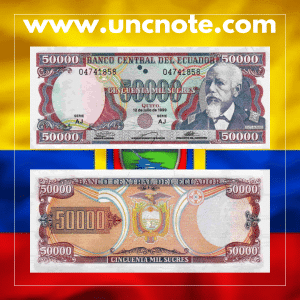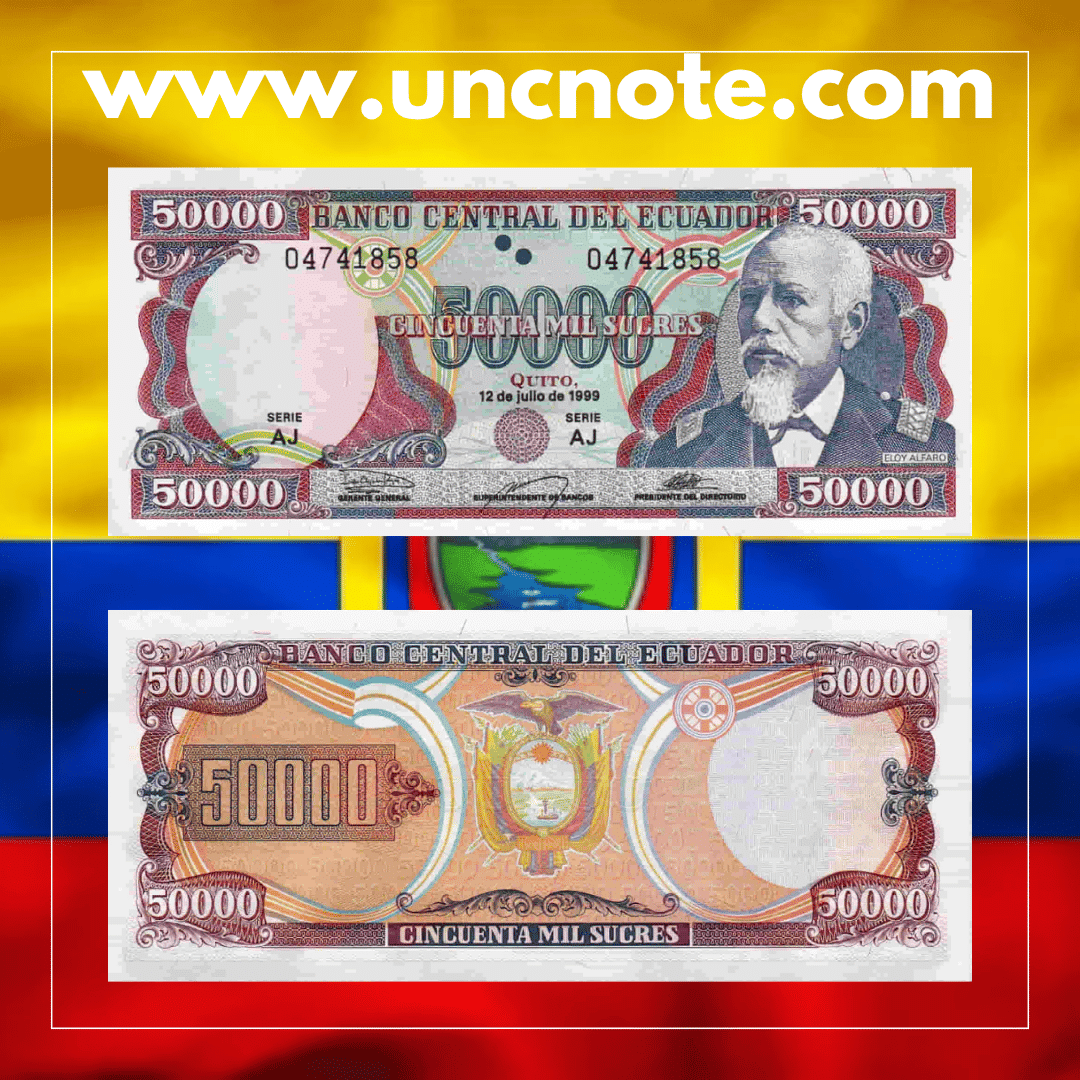
The 50,000 Sucres 1999 banknote was the highest denomination ever issued in Ecuador before the sucre was replaced by the U.S. dollar in 2000. It reflects the extreme inflation that marked the country’s economic crisis of the late 1990s.
On the obverse, it features Dr. Eugenio Espejo (1747–1795), a physician, journalist, and revolutionary thinker, considered one of the precursors of Ecuador’s independence and a pioneer of medicine and public health in Quito.
The reverse depicts the National Congress building in Quito, symbolizing democracy and governance.
The note is printed on cotton paper with advanced security features for its time: a watermark of Eugenio Espejo, a security thread, microtext, and latent images.
Dimensions: 170 × 75 mm.
Obverse
Eloy Alfaro (1842-1912), was an Ecuadorian politician who served as the President of Ecuador from 1895 to 1901 and from 1906 to 1911
Script: Latin
Reverse
National Coat of Arms of Ecuador
Script: Latin
Watermark

© gyoschak (CC BY-NC-SA)
Comments


© gyoschak
Features
| Issuer | Ecuador |
|---|---|
| Issuing bank | Central Bank of Ecuador (Banco Central del Ecuador) |
| Period | Republic (1830-date) |
| Type | Standard circulation banknotes |
| Years | 1995-1999 |
| Value | 50 000 Sucres (50 000 ECS) |
| Currency | Sucre (1884-2000) |
| Composition | Paper |
| Size | 140 × 65 mm |
| Shape | Rectangular |
| Demonetized | Yes |