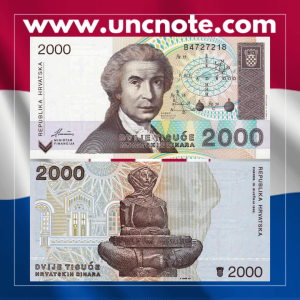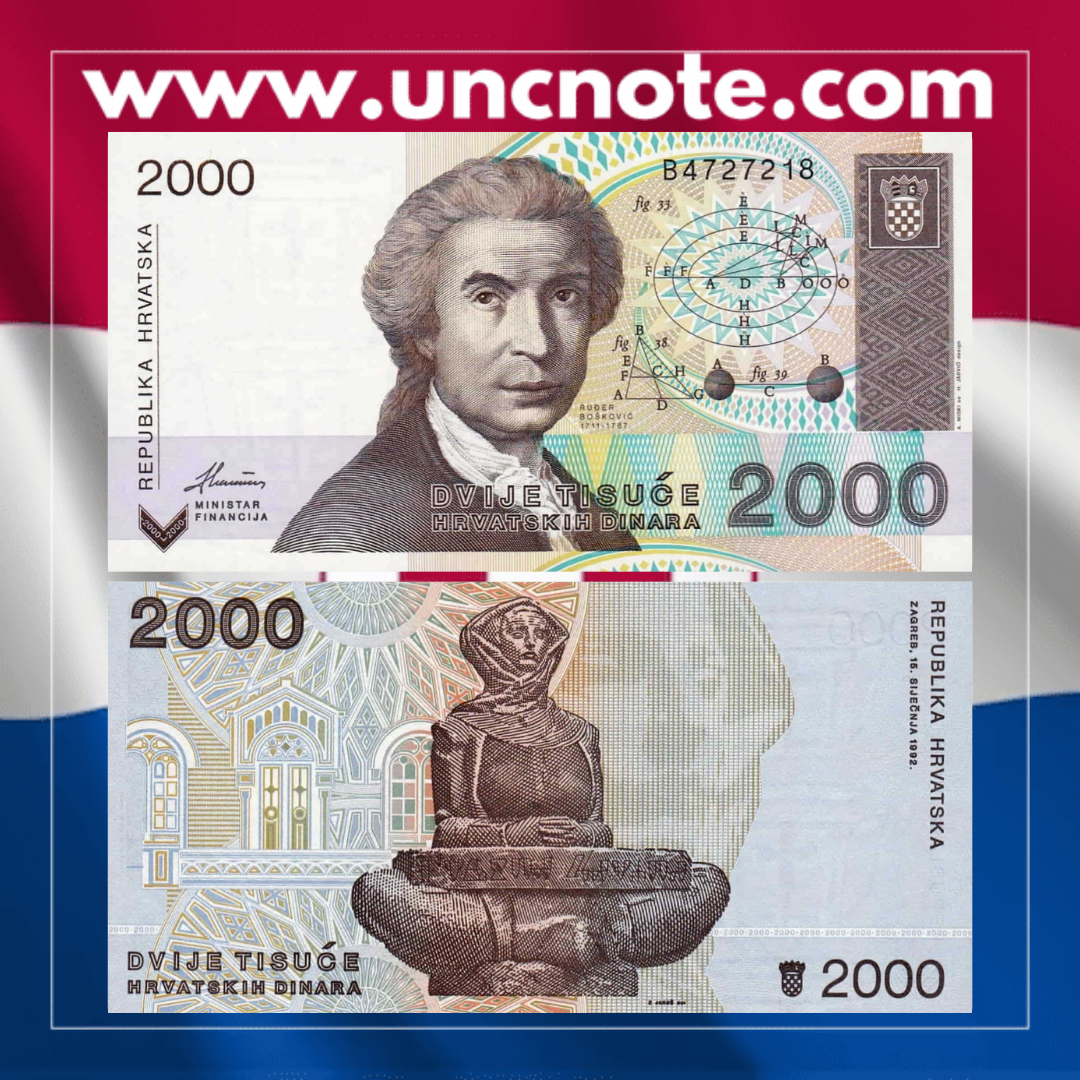
Croatia 2000 Dinara Ruđer Bošković 1992 Pick 23 UNC Banknote
The Croatia 2000 Dinara 1992 Pick 23 is an early banknote of independent Croatia and belongs to the country’s transitional Croatian Dinar (Hrvatski dinar) series.
The banknote was issued during a crucial period in Croatian history, shortly after independence from Yugoslavia. Its design features Ruđer Josip Bošković, one of the most celebrated scientists associated with Croatia, together with the country’s national symbols.
The reverse depicts Zagreb Cathedral, creating a combination of science, history and architecture on a banknote from the formative years of the modern Croatian state.
Historical Background
Following Croatia’s declaration of independence in 1991, the country needed to establish a monetary system separate from Yugoslavia.
The Croatian Dinar was introduced on 23 December 1991, replacing the Yugoslav Dinar in Croatia. It was intended as a temporary currency while the country prepared a permanent national monetary unit.
The first Croatian Dinar notes were followed by additional and increasingly large denominations as inflation reduced the currency’s purchasing power.
The 2,000 Dinara denomination belongs to this transitional period and is dated 1992.
The Croatian Dinar remained in circulation until 30 May 1994, when it was replaced by the Croatian Kuna at:
1 Kuna = 1,000 Croatian Dinara
This means the nominal conversion value of the 2,000 Dinara note was 2 Kuna.
Technical Specifications
- Country: Croatia
- Denomination: 2,000 Dinara
- Year: 1992
- Pick Number: P-23
- Condition: Uncirculated (UNC)
- Issuer: National Bank of Croatia
- Currency: Croatian Dinar (HRD)
- Material: Paper
- Portrait: Ruđer Josip Bošković
- Reverse: Zagreb Cathedral
- Type: Standard circulation banknote
- Status: Withdrawn currency
- Period: Early independent Croatia
Obverse
The obverse features:
- Portrait of Ruđer Josip Bošković
- Croatian Coat of Arms
- 2,000 Dinara denomination
- National Bank inscriptions
- Serial number
- Geometric background patterns
- Croatian national design elements
Ruđer Josip Bošković (1711–1787) was a mathematician, physicist, astronomer, philosopher and diplomat born in Dubrovnik.
His scientific interests were remarkably broad, covering astronomy, mathematics, optics, geodesy and theories concerning the structure of matter.
His international reputation made him a fitting historical personality for the currency of the newly independent Croatia.
Reverse
The reverse features:
- Zagreb Cathedral
- Architectural imagery
- Large 2000 denomination
- Croatian inscriptions
- Ornamental patterns
The cathedral is one of the most recognisable landmarks of Zagreb, Croatia’s capital.
Its inclusion on the Croatian Dinar helped establish a distinctly Croatian visual identity for the new currency at a time when the country was separating its political and monetary institutions from those of Yugoslavia.
Why Add This Banknote to Your Collection?
The Croatia 2000 Dinara Ruđer Bošković 1992 Pick 23 UNC banknote is an affordable piece of currency from the earliest years of modern independent Croatia.
It is particularly suitable for collectors of Croatian banknotes, former Yugoslav currencies, European notes, scientists on banknotes, independence-era currency, architecture and vintage UNC world paper money.
Collector’s Note
The Croatian Dinar is particularly interesting because it was an intentionally transitional currency and circulated for less than three years.
The 2,000 Dinara P-23 also provides an excellent comparison with the much larger Croatian denominations that followed. As inflation progressed, Croatia eventually issued notes denominated in hundreds of thousands and millions of Dinara.
This means a collection can visually document the country’s inflation simply by following the denominations issued during this short period.
The portrait of Ruđer Bošković was reused across multiple Croatian Dinar denominations, giving the series a highly consistent visual identity despite the rapidly increasing face values.
For UNCNOTE, I would keep the spelling “Ruđer Bošković” in the main description for accuracy, while the simpler spelling “Ruder Boskovic” can also be included naturally in SEO metadata because collectors frequently search without Croatian diacritics.