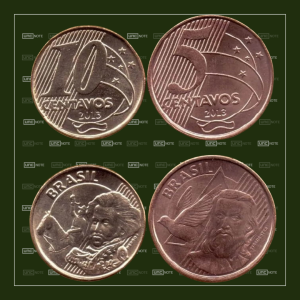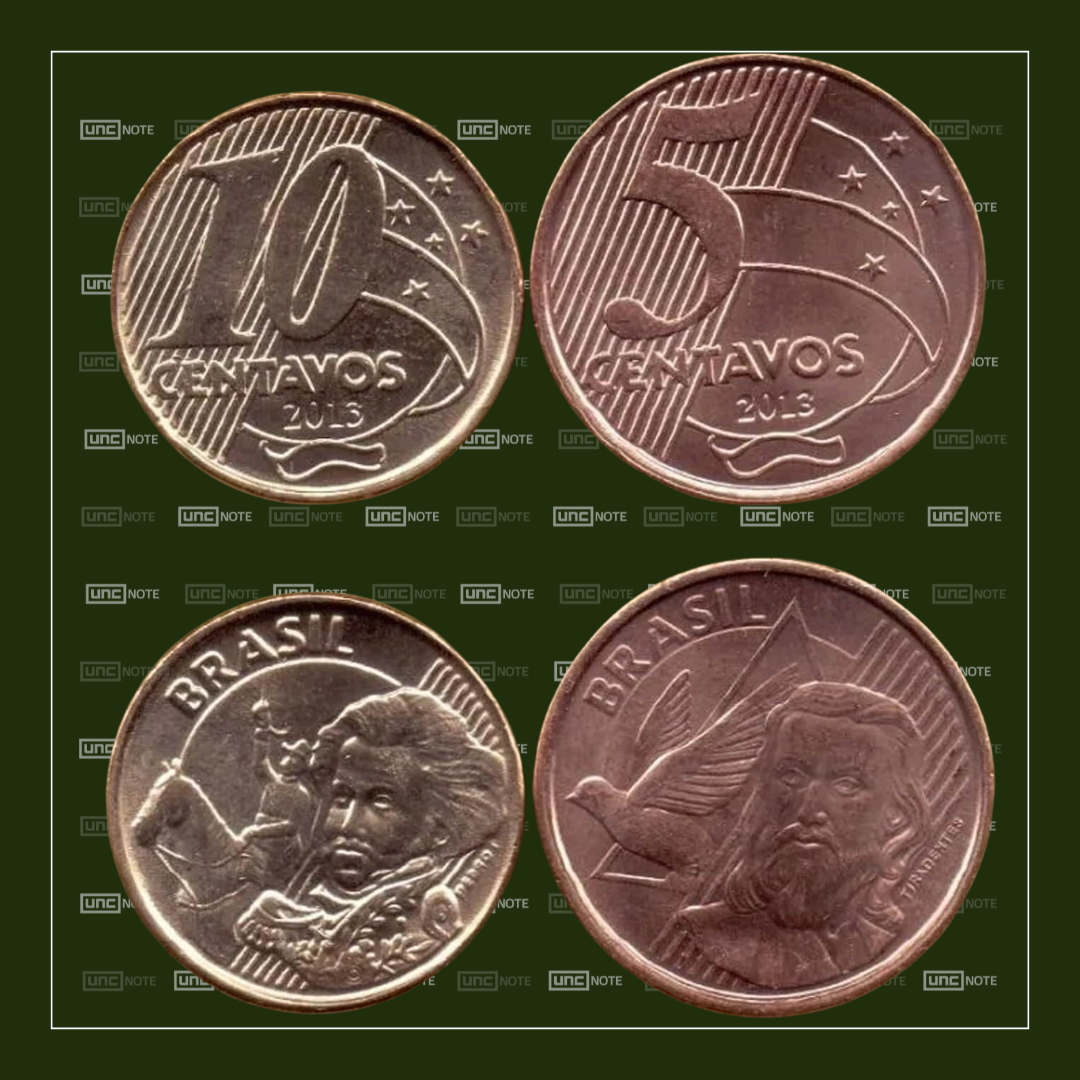
Brazil Set of 2 Coins 5 & 10 Centavos 2013 KM 648–649 UNC
The Brazil 5 and 10 Centavos 2013 Coin Set brings together two denominations from the country’s modern circulation coinage, featuring important personalities associated with Brazilian history and independence.
Issued under the Brazilian Real monetary system, these coins belong to the second family of circulation coins introduced in 1998.
The 5 Centavos coin honours Tiradentes, a leading figure in Brazil’s early independence movement, while the 10 Centavos coin features Dom Pedro I, Brazil’s first emperor.
Both coins are dated 2013 and preserved in uncirculated condition, making this an appealing two-piece collection for collectors of Latin American coins.
Coins Included in the Set
| Denomination | Year | Featured personality |
|---|---|---|
| 5 Centavos | 2013 | Tiradentes |
| 10 Centavos | 2013 | Emperor Pedro I |
Total: 2 coins
Historical Background
Brazil declared independence from Portugal on 7 September 1822, establishing the foundations of an independent Brazilian state.
The country’s independence movement had been influenced by earlier political developments, including the Inconfidência Mineira of 1789.
Two important figures connected with these historical events appear on the coins in this set.
Tiradentes became a symbol of resistance to Portuguese colonial rule, while Dom Pedro I played a decisive role in Brazil’s formal declaration of independence.
By featuring these personalities, Brazil’s modern coinage connects everyday currency with important chapters of national history.
Coin Specifications
| Feature | Details |
|---|---|
| Country | Brazil |
| Issuing authority | Central Bank of Brazil |
| Number of coins | 2 |
| Denominations | 5 and 10 Centavos |
| Year | 2013 |
| Catalogue references supplied | KM 648 and KM 649 |
| Currency | Brazilian Real (BRL) |
| Condition | Uncirculated (UNC) |
| Composition | Copper-plated steel |
| Series | Second Family of Real Coins |
| Type | Circulation coins |
| Region | South America |
Obverse
The obverse designs feature two important personalities from Brazilian history.
5 Centavos – Tiradentes
The 5 Centavos coin depicts Joaquim José da Silva Xavier (1746–1792), commonly known as Tiradentes.
He participated in the Inconfidência Mineira, a movement opposing Portuguese colonial rule in the late eighteenth century.
Tiradentes was executed in 1792 and later became a national symbol of Brazilian independence.
10 Centavos – Emperor Pedro I
The 10 Centavos coin features Dom Pedro I (1798–1834), Brazil’s first emperor.
Pedro I declared Brazil’s independence from Portugal in 1822 and ruled the country until 1831.
His portrait commemorates one of the most significant figures in the establishment of independent Brazil.
Reverse
The reverse of each coin displays its respective denomination:
-
5 Centavos
-
10 Centavos
The designs incorporate the year 2013 and stylised elements associated with Brazil’s modern circulation coinage.
Both coins share a common visual identity, making them particularly suitable for a coordinated denomination collection.
The Brazilian Real
The Brazilian Real (BRL) was introduced on 1 July 1994 as part of the Plano Real, a major economic stabilisation programme designed to combat inflation.
The currency replaced the Cruzeiro Real and became a turning point in Brazil’s monetary history.
One Real is divided into 100 Centavos.
In 1998, Brazil introduced its second family of circulation coins, featuring historical personalities and a redesigned appearance.
The 5 and 10 Centavos coins dated 2013 belong to this modern coin family.
Tiradentes and Brazil’s Independence Movement
Tiradentes is remembered as one of Brazil’s most important national heroes.
He participated in the Inconfidência Mineira, a movement that sought greater independence from Portuguese colonial authority.
Although the movement was unsuccessful, Tiradentes became a powerful symbol of the struggle for independence.
His execution on 21 April 1792 is commemorated annually in Brazil through the national holiday known as Dia de Tiradentes.
His portrait on the 5 Centavos coin recognises his lasting historical importance.
Emperor Pedro I and Brazilian Independence
Dom Pedro I played a decisive role in Brazil’s transition from Portuguese colony to independent empire.
On 7 September 1822, he proclaimed Brazil’s independence, an event traditionally associated with the Grito do Ipiranga.
He subsequently became the country’s first emperor.
His reign marked the beginning of Brazil’s independent constitutional monarchy.
The 10 Centavos coin honours his role in the creation of the Brazilian state.
Why Add This Coin Set to Your Collection?
The Brazil Set of 2 Coins 5 & 10 Centavos 2013 UNC combines several attractive collecting themes:
-
Two denominations: 5 and 10 Centavos from the Brazilian Real system.
-
Historical personalities: Tiradentes and Emperor Pedro I.
-
Brazilian independence: coins connected with important figures in the country’s history.
-
Matching year: both coins dated 2013.
-
Uncirculated condition: preserved without normal circulation wear.
This set is particularly suitable for collectors of modern Brazilian coins, South American currency and historical personalities depicted on world coinage.