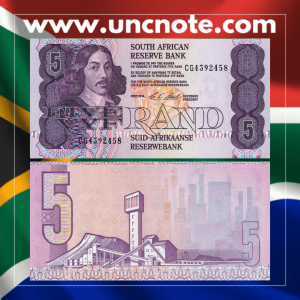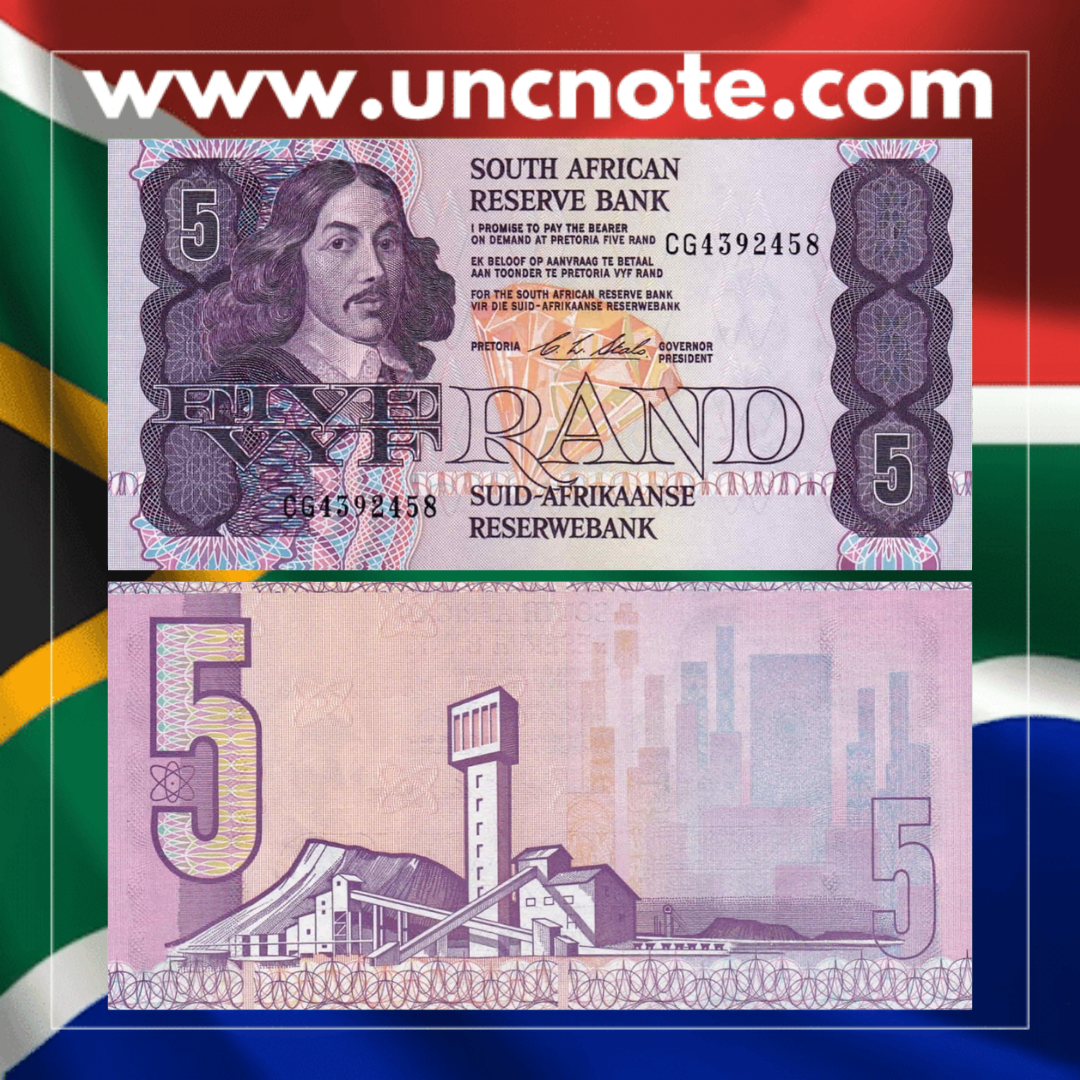
South Africa 5 Rand Bartholomeus Vermuyden 1990–1994 Pick 119e UNC Banknote
The South Africa 5 Rand Pick 119e is a historical banknote associated with the final years of South Africa’s traditional portrait-based currency series.
Issued by the South African Reserve Bank, this denomination features a portrait conventionally identified as Jan van Riebeeck, the Dutch colonial administrator associated with the establishment of a settlement at the Cape of Good Hope in 1652.
The portrait has also attracted historical discussion concerning a possible connection to Bartholomeus Vermuyden, making it an interesting subject for collectors of historical banknote imagery.
The supplied 1990–1994 date range places this note within a period of major political transformation in South Africa, including the dismantling of apartheid and the country’s transition to democratic government.
Preserved in uncirculated condition, this 5 Rand banknote is an attractive addition to collections of African paper money and twentieth-century world currencies.
Historical Background
South Africa introduced the Rand in 1961, replacing the South African Pound and establishing a decimal currency system.
For several decades, South African banknotes prominently featured a portrait traditionally associated with Jan van Riebeeck.
These designs reflected the historical narratives and national imagery selected by the country’s authorities during the twentieth century.
The early 1990s brought significant political changes.
In 1990, Nelson Mandela was released from prison, and negotiations began to dismantle the apartheid system.
South Africa held its first democratic national elections based on universal adult suffrage in April 1994, resulting in Nelson Mandela becoming president.
During this period, South African banknote designs also underwent important changes, with wildlife-themed currency introduced in the early 1990s.
The 5 Rand Pick 119e therefore represents an earlier chapter in the country’s monetary history.
Banknote Specifications
| Feature | Details |
|---|---|
| Country | South Africa |
| Issuing authority | South African Reserve Bank |
| Denomination | 5 Rand |
| Date range supplied | 1990–1994 |
| Catalogue reference supplied | Pick 119e |
| Currency | South African Rand (ZAR) |
| Condition | Uncirculated (UNC) |
| Material | Paper |
| Type | Circulation banknote |
| Portrait | Traditionally identified as Jan van Riebeeck |
| Alternative portrait attribution | Bartholomeus Vermuyden |
| Historical period | Late apartheid era and democratic transition |
| Region | Southern Africa |
Obverse
The obverse features the familiar historical portrait traditionally identified as Jan van Riebeeck (1619–1677).
Van Riebeeck was a Dutch colonial administrator who established a supply station at the Cape of Good Hope in 1652 on behalf of the Dutch East India Company.
The portrait appeared on South African currency for several decades and became one of the most recognisable elements of the country’s earlier banknote designs.
The note also incorporates the denomination of 5 Rand, the name of the issuing authority and decorative security patterns characteristic of the period.
The historical identification of the portrait has been questioned, with Bartholomeus Vermuyden mentioned in alternative attributions.
Reverse
The reverse features decorative artwork characteristic of South African banknotes from the late twentieth century.
The design reflects the country’s earlier approach to currency illustration, before wildlife imagery became the dominant theme of South African banknotes.
The exact reverse motifs and inscriptions should be verified against the physical Pick 119e variety before publication.
Bartholomeus Vermuyden and the Portrait Debate
One of the most interesting aspects of older South African banknotes is the historical debate surrounding the portrait traditionally identified as Jan van Riebeeck.
Some discussions have suggested that the portrait may instead depict Bartholomeus Vermuyden, a historical figure associated with seventeenth-century Dutch portraiture.
The question highlights the difficulties historians sometimes encounter when identifying individuals in early European artworks.
Portraits were frequently copied, reproduced and adapted over time, and their original identities were not always reliably documented.
For collectors, this debate adds an additional historical dimension to South African banknotes featuring the familiar portrait.
However, the Vermuyden attribution should be regarded as unconfirmed, rather than an established identification.
Jan van Riebeeck and South African History
Jan van Riebeeck was born on 21 April 1619 in the Dutch Republic.
He worked for the Dutch East India Company, commonly known as the VOC.
In 1652, he established a refreshment station at the Cape of Good Hope to supply ships travelling between Europe and Asia.
The settlement developed into a permanent European colonial presence in southern Africa.
Van Riebeeck became a prominent figure in the historical narratives of South Africa’s colonial period.
His image was used extensively on the country’s banknotes before the introduction of wildlife-themed designs.
Today, his historical role is considered within the broader context of European colonial expansion and its consequences for Indigenous communities.
South Africa’s Democratic Transition, 1990–1994
The period between 1990 and 1994 was one of the most important in modern South African history.
Several major developments transformed the country’s political system:
| Year | Historical event |
|---|---|
| 1990 | Nelson Mandela released from prison |
| 1991 | Major apartheid legislation repealed |
| 1993 | Nelson Mandela and F. W. de Klerk awarded the Nobel Peace Prize |
| 1994 | First democratic national elections based on universal adult suffrage |
| 1994 | Nelson Mandela inaugurated as president |
These developments marked the end of apartheid and the beginning of a new democratic era.
Banknotes associated with this period provide collectors with tangible examples of South Africa’s monetary history during a time of profound national change.
The South African Rand
The South African Rand (ZAR) was introduced on 14 February 1961, replacing the South African Pound.
The conversion rate was:
2 Rand = 1 South African Pound
The currency takes its name from the Witwatersrand, the region historically associated with South Africa’s gold-mining industry.
One Rand is divided into 100 Cents.
The South African Reserve Bank, established in 1921, is responsible for issuing the country’s banknotes and coins.
Throughout its history, the Rand has undergone several design changes reflecting South Africa’s evolving political and cultural identity.
The Evolution of South African Banknotes
South African banknote designs have changed significantly since the introduction of the Rand.
| Period | Main design theme |
|---|---|
| 1961–early 1990s | Historical portraits traditionally associated with Jan van Riebeeck |
| From 1992 | Big Five African wildlife |
| From 2012 | Nelson Mandela and wildlife |
| From 2023 | Redesigned Nelson Mandela and Big Five series |
The transition from historical portraits to wildlife imagery marked an important change in South African currency design.
The later introduction of Nelson Mandela’s portrait further reflected the country’s democratic history.
The 5 Rand Pick 119e belongs to the earlier portrait-based tradition.
Collecting Historical South African Banknotes
South African paper money offers collectors an opportunity to explore different periods of the country’s history through currency design.
The earlier Rand series is particularly interesting because of its historical portraits, decorative engravings and association with the country’s twentieth-century monetary system.
The 5 Rand 1990–1994 Pick 119e can complement collections featuring other denominations from the same period, including the 1, 2, 10 and 20 Rand banknotes.
It also provides an interesting contrast with the later wildlife-themed and Nelson Mandela series.
Why Add This Banknote to Your Collection?
The South Africa 5 Rand 1990–1994 Pick 119e UNC Banknote offers several attractive collecting features:
-
Historical portrait: traditionally identified as Jan van Riebeeck, with a debated alternative attribution.
-
Important historical period: associated with South Africa’s transition towards democracy.
-
Vintage currency design: represents an earlier generation of South African banknotes.
-
Uncirculated condition: preserved without normal circulation wear.
-
Numismatic interest: combines monetary history with historical portrait research.
-
African banknote collection: complements other South African Rand denominations from the twentieth century.