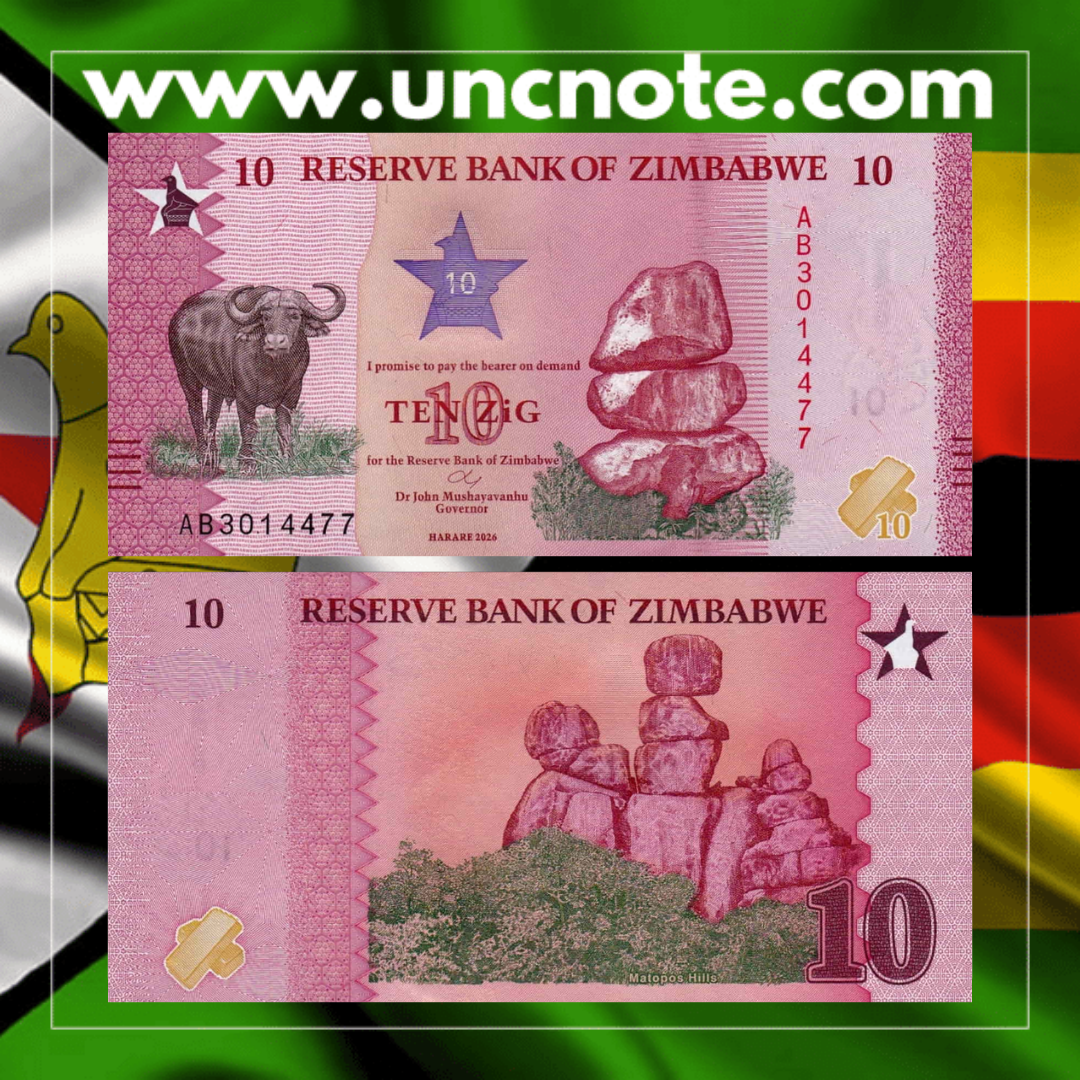
Zimbabwe 10 ZiG African Buffalo 2026 Pick 115 UNC Banknote
The Zimbabwe 10 ZiG 2026 Pick 115 is a modern African banknote associated with Zimbabwe’s new national currency, the Zimbabwe Gold (ZiG).
Featuring the African buffalo (Syncerus caffer), one of Africa’s most recognisable wild animals, this denomination combines wildlife imagery with an important chapter in Zimbabwe’s monetary history.
The ZiG currency was introduced in April 2024 by the Reserve Bank of Zimbabwe as part of efforts to establish a more stable domestic monetary system.
Its introduction followed decades of currency reforms, inflation and changes to Zimbabwe’s national banknotes.
The 10 ZiG 2026 issue represents a more recent stage in the development of this currency.
Preserved in uncirculated condition, this banknote is an interesting addition to collections of African paper money, wildlife-themed currency and contemporary monetary issues.
Historical Background
Zimbabwe gained independence from the United Kingdom on 18 April 1980, following the end of white-minority rule in Rhodesia.
The country introduced the Zimbabwean Dollar in 1980, replacing the Rhodesian Dollar.
During the following decades, Zimbabwe experienced major economic challenges, including extremely high inflation and repeated currency reforms.
In 2009, the Zimbabwean Dollar was effectively abandoned in favour of foreign currencies, including the United States Dollar.
A new Zimbabwean Dollar was introduced in 2019, but continued inflation and currency depreciation created further difficulties.
On 5 April 2024, the Reserve Bank of Zimbabwe announced the introduction of the Zimbabwe Gold (ZiG) currency.
The new monetary system was designed to be supported by reserve assets, including gold and foreign currencies.
The 10 ZiG 2026 banknote belongs to this latest chapter in Zimbabwe’s monetary development.
Banknote Specifications
| Feature | Details |
|---|---|
| Country | Zimbabwe |
| Issuing authority | Reserve Bank of Zimbabwe |
| Denomination | 10 ZiG |
| Year | 2026 |
| Catalogue reference supplied | Pick 115 |
| Currency | Zimbabwe Gold (ZiG) |
| Currency code | ZWG |
| Condition | Uncirculated (UNC) |
| Type | Circulation banknote |
| Featured wildlife | African buffalo |
| Monetary system | Zimbabwe Gold |
| Region | Southern Africa |
| ZiG introduced | 2024 |
The 2026 date, buffalo design and Pick 115 reference are supplied catalogue details and should be confirmed against the physical banknote. “Nuevo” is not part of the Pick number.
Obverse
The obverse of Zimbabwe’s ZiG banknote series incorporates national imagery associated with the country’s historical and cultural heritage.
A prominent recurring motif on Zimbabwean currency is the Chiremba Balancing Rocks, a natural rock formation near Harare.
The balancing rocks have appeared on several generations of Zimbabwean banknotes and are among the country’s most recognisable monetary symbols.
The denomination of 10 Zimbabwe Gold, official inscriptions and security elements form part of the banknote’s design.
The exact arrangement of these elements on the 2026 Pick 115 variety should be verified against the physical specimen.
Reverse
The reverse is identified by the supplier as featuring an African buffalo (Syncerus caffer).
The African buffalo is one of the famous Big Five animals, alongside the elephant, lion, leopard and rhinoceros.
Buffalo inhabit grasslands, savannas and woodland environments across sub-Saharan Africa.
They are powerful herd animals known for their strength, social behaviour and distinctive curved horns.
The buffalo imagery celebrates Africa’s wildlife heritage and connects the banknote with Zimbabwe’s natural environment.
The precise illustration and additional reverse details should be checked against the physical banknote.
The Big Five of Africa
The term Big Five traditionally refers to five large African animals:
| Animal | Scientific name |
|---|---|
| African elephant | Loxodonta africana |
| African lion | Panthera leo |
| African leopard | Panthera pardus |
| African buffalo | Syncerus caffer |
| Rhinoceros | Diceros bicornis / Ceratotherium simum |
Originally associated with big-game hunting, the term is now widely used in wildlife tourism and conservation.
Zimbabwe is one of the African countries where these animals form an important part of the natural heritage.
Banknotes featuring Big Five species are particularly appealing to collectors interested in wildlife and nature.
Zimbabwe Gold (ZiG): A New Currency Introduced in 2024
The Zimbabwe Gold (ZiG) currency was introduced on 5 April 2024 by the Reserve Bank of Zimbabwe.
The name reflects the country’s intention to support the currency through reserve assets, including gold.
ZiG replaced the previous Zimbabwean Dollar as the country’s official domestic currency.
At its introduction, the authorities announced a conversion rate of approximately 13.56 Zimbabwean Dollars per US Dollar-equivalent ZiG unit, with the precise exchange arrangements determined by the Reserve Bank.
Unlike Zimbabwe’s earlier currencies, ZiG was presented as a reserve-backed monetary system.
However, the currency’s long-term stability depends on monetary policy, reserve management, public confidence and broader economic conditions.
The 10 ZiG 2026 banknote is associated with the development of this new monetary framework.
Zimbabwe’s Monetary History
Zimbabwe has experienced several major changes to its national currency since independence.
| Year | Monetary development |
|---|---|
| 1980 | First Zimbabwean Dollar introduced |
| 2006 | Currency redenomination |
| 2008 | Further redenomination during hyperinflation |
| 2009 | Zimbabwean Dollar abandoned in favour of foreign currencies |
| 2016 | Bond notes introduced |
| 2019 | Zimbabwean Dollar reintroduced |
| 2024 | Zimbabwe Gold (ZiG) introduced |
| 2026 | Year of the banknote offered here |
This unusual monetary history has made Zimbabwe one of the most interesting countries for modern banknote collectors.
Zimbabwe’s Hyperinflation Era
Zimbabwe became internationally known for its extraordinary inflation during the 2000s.
Rapid monetary expansion, economic instability and declining confidence in the national currency contributed to extreme price increases.
During the final stages of hyperinflation, the Reserve Bank of Zimbabwe issued banknotes with exceptionally large denominations.
These included the famous 100 Trillion Dollars banknote dated 2008.
The country’s hyperinflation-era notes have since become highly recognisable collectibles.
The introduction of ZiG in 2024 represented another attempt to establish a functioning national currency after this turbulent monetary history.
For collectors, the contrast between Zimbabwe’s trillion-dollar banknotes and its newer ZiG denominations is particularly interesting.
The Reserve Bank of Zimbabwe
The Reserve Bank of Zimbabwe is the country’s central bank.
Its responsibilities include issuing national currency, implementing monetary policy and overseeing important aspects of the financial system.
The institution has managed several currency transitions throughout Zimbabwe’s modern history.
These include the introduction of new denominations, redenominations and the adoption of the Zimbabwe Gold currency.
The 10 ZiG 2026 Pick 115 is identified as part of this latest monetary era.
Zimbabwe’s Natural Heritage
Zimbabwe is home to a wide range of landscapes and wildlife habitats.
The country contains savannas, woodlands, river valleys and important protected areas.
Notable natural destinations include:
-
Hwange National Park, known for elephants, buffalo and other large mammals.
-
Mana Pools National Park, famous for wildlife along the Zambezi River.
-
Victoria Falls, one of Africa’s most spectacular waterfalls.
-
Matobo National Park, recognised for its distinctive rock formations.
-
Gonarezhou National Park, part of a major transboundary conservation landscape.
Wildlife tourism and conservation play important roles in Zimbabwe’s national identity.
The African buffalo is a fitting subject for a banknote celebrating the country’s natural heritage.
The 10 ZiG Denomination
The 10 ZiG denomination belongs to Zimbabwe’s new monetary system introduced in 2024.
Modern ZiG banknotes offer collectors an opportunity to study how the country’s currency designs have evolved following earlier periods of monetary instability.
The denomination can be compared with Zimbabwe’s previous Dollar banknotes, including those issued during the hyperinflation era.
Differences in denomination structure, design and currency naming illustrate the country’s changing monetary policies.
The 2026 Pick 115 issue is especially relevant to collectors building a chronological collection of Zimbabwean currency.
Collecting Zimbabwean Banknotes
Zimbabwe is one of the most fascinating countries for modern world banknote collectors because of its complex monetary history.
Its banknotes include issues from several distinct currency periods, ranging from the original Zimbabwean Dollar to the hyperinflation series and the newer ZiG currency.
Collectors can organise Zimbabwean paper money by denomination, monetary reform, issue year or catalogue reference.
The 10 ZiG 2026 Pick 115 can complement earlier Zimbabwe Gold denominations and historical Zimbabwean Dollar banknotes.
Together, these issues illustrate the country’s changing monetary system over more than four decades.
Why Add This Banknote to Your Collection?
The Zimbabwe 10 ZiG African Buffalo 2026 Pick 115 UNC Banknote offers several attractive collecting features:
-
African buffalo design: celebrates one of Africa’s iconic Big Five animals.
-
Zimbabwe Gold currency: represents the monetary system introduced in 2024.
-
2026 issue: associated with a recent stage in Zimbabwe’s currency development.
-
Modern monetary history: illustrates the country’s transition from earlier Zimbabwean Dollar systems.
-
Wildlife-themed banknote: an appealing addition to collections featuring African animals.
-
Uncirculated condition: preserved without normal circulation wear.
-
African numismatics: complements Zimbabwe’s internationally recognised historical banknotes.