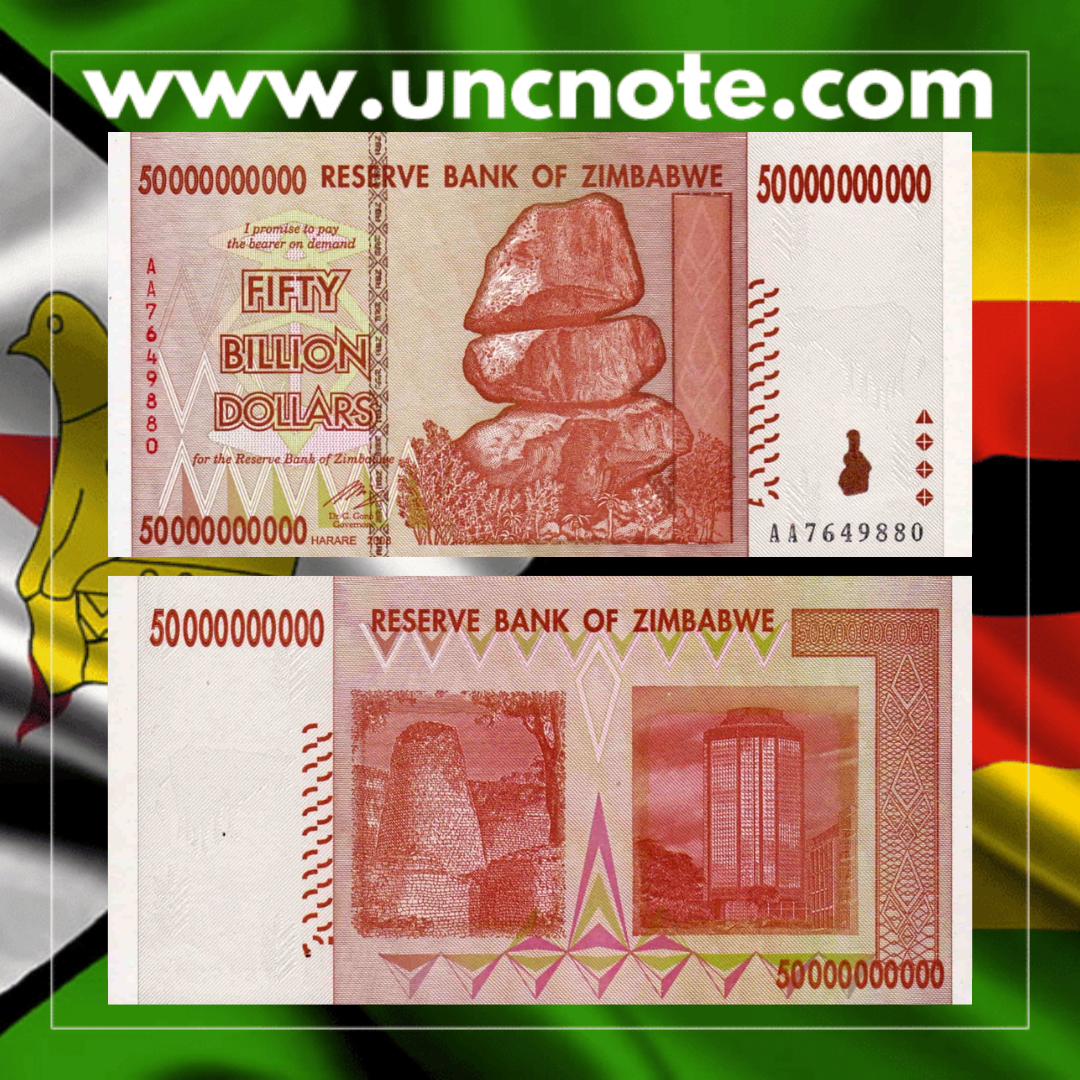
Zimbabwe 50 Billion Dollars 2008 Pick 87 UNC Banknote
The Zimbabwe 50 Billion Dollars 2008 Pick 87 is a remarkable historical African banknote associated with one of the most extreme episodes of hyperinflation ever recorded.
With a denomination of 50,000,000,000 Zimbabwean Dollars, this issue illustrates the extraordinary monetary instability experienced by Zimbabwe during 2008.
Issued by the Reserve Bank of Zimbabwe, the banknote belongs to a period when the country’s national currency was losing purchasing power at an unprecedented rate.
The introduction of increasingly large denominations became necessary as inflation accelerated and everyday transactions required enormous amounts of money.
The 50 Billion Dollars denomination represents an important chapter in Zimbabwe’s monetary history, reflecting the extraordinary economic conditions that eventually led to the abandonment of the Zimbabwean Dollar in 2009.
Preserved in uncirculated condition, this banknote is an attractive addition to collections of African paper money, hyperinflation currencies and unusual world banknote denominations.
Historical Background
Zimbabwe gained independence on 18 April 1980, following the end of white-minority rule in Rhodesia.
The country introduced its first Zimbabwean Dollar in 1980, replacing the Rhodesian Dollar at par.
During its early years, the currency circulated in relatively conventional denominations.
However, economic difficulties intensified during the 1990s and early 2000s.
Inflation accelerated, production declined and confidence in the national currency weakened.
By 2007 and 2008, Zimbabwe was experiencing one of the most severe inflation crises in modern history.
The Reserve Bank introduced increasingly large denominations as the purchasing power of the Zimbabwean Dollar collapsed.
The 50 Billion Dollars 2008 Pick 87 issue belongs to this extraordinary period of monetary instability.
Banknote Specifications
| Feature | Details |
|---|---|
| Country | Zimbabwe |
| Issuing authority | Reserve Bank of Zimbabwe |
| Denomination | 50 Billion Dollars |
| Numerical value | 50,000,000,000 |
| Year | 2008 |
| Catalogue reference supplied | Pick 87 |
| Currency | Zimbabwean Dollar |
| Condition | Uncirculated (UNC) |
| Material | Paper |
| Type | Hyperinflation-era banknote |
| Historical period | Zimbabwe hyperinflation crisis |
| Region | Southern Africa |
The Pick 87 catalogue reference, denomination and exact issue type should be verified against the physical specimen. Zimbabwe issued several high-denomination series during this period, including issues belonging to different redenominated versions of the Zimbabwean Dollar.
Obverse
Zimbabwean currency from the hyperinflation period frequently featured the famous Chiremba Balancing Rocks, one of the country’s most recognisable national symbols.
These distinctive granite formations are located in the Epworth area near Harare.
The balancing rocks have appeared on numerous generations of Zimbabwean banknotes, creating a visual connection between different monetary periods.
The denomination of 50 Billion Dollars reflects the extraordinary economic conditions of 2008.
The banknote also incorporates official inscriptions, decorative patterns and security features.
The exact obverse artwork, signature combination and security characteristics of the Pick 87 issue should be confirmed against the physical specimen.
Reverse
Zimbabwean banknotes from this period frequently incorporated imagery associated with the country’s national heritage, wildlife, agriculture and important landmarks.
These designs helped maintain a recognisable national identity despite the introduction of rapidly changing denominations.
The reverse of the 50 Billion Dollars 2008 Pick 87 issue should be examined to confirm its specific illustration and design characteristics.
The precise reverse motif is not asserted here without verification of the physical specimen.
Understanding the 50 Billion Dollars Denomination
Face value
50,000,000,000
Fifty Billion Zimbabwean Dollars
The denomination represents fifty billion Zimbabwean Dollars.
In English, the correct denomination is 50 Billion Dollars, equivalent to 50,000,000,000 Dollars.
Although the numerical value appears enormous, its purchasing power during Zimbabwe’s hyperinflation crisis was severely affected by rapidly rising prices.
As inflation accelerated, the cost of ordinary goods and services increased dramatically.
Transactions that had previously required relatively small amounts of money began requiring millions and eventually billions of Dollars.
The Reserve Bank responded by introducing increasingly large denominations.
The 50 Billion Dollars 2008 issue provides a striking illustration of the difference between a currency’s nominal value and its actual purchasing power.
Zimbabwe’s Hyperinflation Crisis
Zimbabwe experienced one of the most extreme episodes of hyperinflation recorded in modern economic history.
Hyperinflation occurs when prices increase at an exceptionally rapid rate, causing money to lose purchasing power.
Zimbabwe’s crisis was associated with several economic factors, including declining production, fiscal pressures, monetary expansion and a loss of confidence in the national currency.
By 2008, inflation had reached extraordinary levels.
Everyday transactions became increasingly difficult as prices changed rapidly.
The Reserve Bank introduced monetary instruments with denominations reaching millions, billions and eventually trillions of Dollars.
The 50 Billion Dollars 2008 Pick 87 is a tangible reminder of this extraordinary monetary crisis.
Zimbabwe’s Currency Redenominations
Zimbabwe attempted to simplify its monetary system through several redenominations.
In August 2006, the Reserve Bank introduced the second Zimbabwean Dollar, removing three zeros from the previous currency.
In August 2008, another redenomination removed ten zeros.
A further reform followed in February 2009, removing twelve additional zeros.
| Year | Monetary development |
|---|---|
| 1980 | First Zimbabwean Dollar introduced |
| August 2006 | 1 new Dollar replaced 1,000 old Dollars |
| August 2008 | 1 new Dollar replaced 10 billion previous Dollars |
| February 2009 | 1 new Dollar replaced 1 trillion previous Dollars |
| 2009 | Zimbabwean Dollar effectively abandoned |
| 2016 | Bond notes introduced |
| 2019 | Zimbabwean Dollar reintroduced |
| 2024 | Zimbabwe Gold (ZiG) introduced |
These successive reforms demonstrate the extraordinary scale of Zimbabwe’s monetary instability.
For collectors, identifying the correct monetary system is essential because denominations from different redenominated currencies cannot be compared directly.
Zimbabwe in 2008
The year 2008 was one of the most challenging periods in Zimbabwe’s modern history.
The country experienced severe economic instability, shortages of essential goods and rapidly rising prices.
President Robert Mugabe, who had led Zimbabwe since independence, remained in power.
Presidential and parliamentary elections took place in March 2008, followed by a disputed presidential runoff in June.
Political negotiations eventually produced a power-sharing agreement in September 2008.
At the same time, the national currency was losing purchasing power at an extraordinary rate.
The 50 Billion Dollars 2008 banknote provides collectors with a historical connection to these events.
From Millions to Trillions
Zimbabwe’s hyperinflation-era banknotes became internationally famous because of their extraordinary denominations.
During the crisis, the Reserve Bank introduced monetary values that increased dramatically over a relatively short period.
Banknotes and other monetary instruments with denominations in the millions and billions became part of everyday economic life.
Eventually, Zimbabwe issued banknotes with face values reaching trillions of Dollars.
One of the most famous examples is the 100 Trillion Dollars banknote, dated 2008 and issued in January 2009.
Its numerical denomination was:
100,000,000,000,000 Zimbabwean Dollars
However, Zimbabwe’s successive redenominations mean that these enormous face values belonged to different monetary units.
They cannot be compared directly without accounting for the currency reforms.
The 50 Billion Dollars 2008 issue provides an important example of the country’s rapidly evolving monetary system.
Chiremba Balancing Rocks
The Chiremba Balancing Rocks are among Zimbabwe’s most recognisable natural landmarks.
Located near Harare, they consist of large granite formations balanced in unusual natural arrangements.
Their distinctive appearance results from geological weathering and erosion over long periods.
The balancing rocks became a prominent symbol of Zimbabwean national identity following independence.
They have appeared on numerous generations of Zimbabwean currency, including issues from the original Dollar series, the hyperinflation period and later monetary systems.
For collectors, the balancing rocks provide a visual connection between different chapters of Zimbabwe’s currency history.
The Reserve Bank of Zimbabwe
The Reserve Bank of Zimbabwe is Zimbabwe’s central bank.
Its responsibilities include issuing national currency, implementing monetary policy and overseeing important aspects of the financial system.
During the hyperinflation crisis, the institution introduced numerous new denominations and monetary instruments.
These included conventional banknotes, bearer cheques and other temporary currency arrangements.
The 50 Billion Dollars 2008 Pick 87 issue is associated with this period of monetary experimentation and rapid economic change.
The End of the Zimbabwean Dollar in 2009
By early 2009, the Zimbabwean Dollar had lost much of its practical usefulness as a medium of exchange.
Foreign currencies, particularly the United States Dollar and South African Rand, became increasingly important in everyday transactions.
Zimbabwe effectively abandoned its national currency in favour of a multicurrency system.
This transition marked the end of the extraordinary hyperinflation period.
The country’s later attempts to restore a domestic currency included bond notes in 2016, a reintroduced Zimbabwean Dollar in 2019 and Zimbabwe Gold in 2024.
For collectors, the banknotes issued during 2008 remain among the most recognisable symbols of Zimbabwe’s monetary crisis.
Collecting Zimbabwean Hyperinflation Banknotes
Zimbabwe is particularly popular among collectors because of its extraordinary currency history.
Its paper money includes issues from the original Zimbabwean Dollar, multiple redenominations, bearer cheques, hyperinflation-era banknotes and the newer Zimbabwe Gold monetary system.
Collectors can organise Zimbabwean currency by denomination, issue year, monetary reform or catalogue reference.
The 50 Billion Dollars 2008 Pick 87 is especially interesting because of its extraordinary face value and historical context.
It can complement other high-denomination issues such as the Zimbabwe 10 Billion Dollars 2008 Pick 85 and Zimbabwe 100 Billion Dollars 2008 Pick 64, subject to verification of their catalogue references.
Together, these banknotes illustrate the dramatic evolution of Zimbabwe’s monetary system.
Why Add This Banknote to Your Collection?
The Zimbabwe 50 Billion Dollars 2008 Pick 87 UNC Banknote offers several attractive collecting features:
-
Extraordinary denomination: features a face value of 50,000,000,000 Dollars.
-
Hyperinflation history: represents one of the most dramatic monetary crises in modern history.
-
2008 issue: associated with Zimbabwe’s period of extreme currency depreciation.
-
Historical significance: illustrates the consequences of severe monetary instability.
-
Uncirculated condition: preserved without normal circulation wear.
-
African numismatics: an interesting addition to collections of Southern African paper money.
-
Economic history: provides a tangible example of hyperinflation and currency redenomination.
-
Unusual denomination collection: complements other high-value banknotes from around the world.