Sierra Leone 500 Leones Kai Londo 1998 Pick 23b UNC Banknote
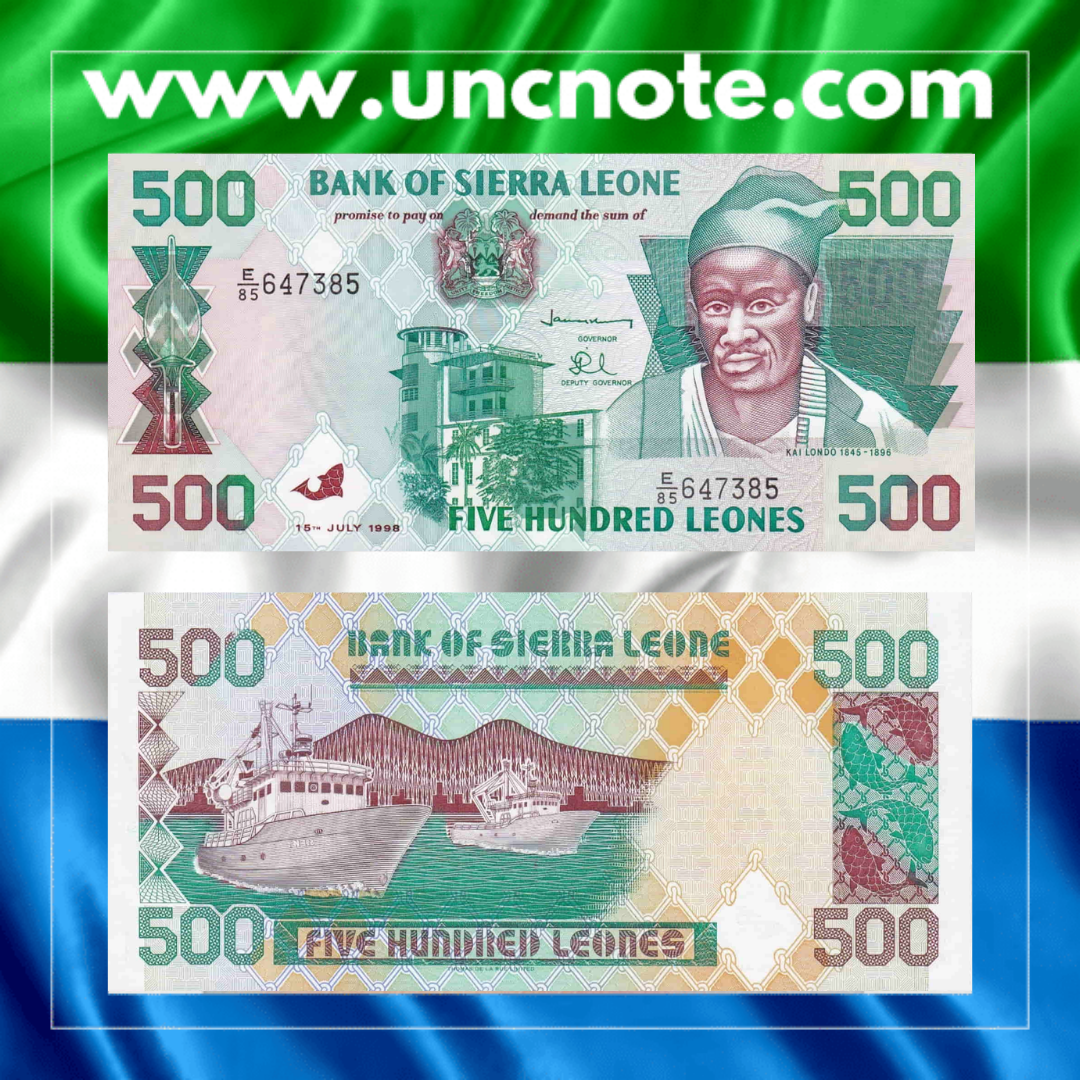
The Sierra Leone 500 Leones 1998 Pick 23b is a historical African banknote featuring Kai Londo, a prominent figure associated with Sierra Leone’s nineteenth-century history.
Issued by the Bank of Sierra Leone, this denomination belongs to the country’s original Leone currency system, introduced in 1964.
The banknote celebrates Sierra Leone’s historical heritage through its depiction of a figure associated with local leadership and resistance during the period of expanding European colonial influence.
The year 1998 is particularly significant in Sierra Leone’s modern history, as the country was experiencing the devastating effects of its civil war.
With a denomination of 500 Leones, this issue provides collectors with a connection to both the country’s monetary development and its complex historical background.
Preserved in uncirculated condition, the banknote is an appealing addition to collections of African paper money, historical personalities and twentieth-century world currencies.
Historical Background
Sierra Leone is a West African country located on the Atlantic coast, bordered by Guinea and Liberia.
Its modern history reflects centuries of interaction between indigenous communities, regional trading networks and European colonial powers.
The settlement of Freetown developed during the late eighteenth century as a destination for formerly enslaved Africans.
In 1808, Freetown and its surrounding territory became a British Crown Colony.
British influence subsequently expanded into the interior, where numerous communities maintained their own political structures and traditional authorities.
Sierra Leone gained independence from the United Kingdom on 27 April 1961.
Three years later, in 1964, the country introduced the Leone as its national currency, replacing the British West African Pound.
The 500 Leones 1998 banknote belongs to this original monetary system.
Banknote Specifications
| Feature | Details |
|---|---|
| Country | Sierra Leone |
| Issuing authority | Bank of Sierra Leone |
| Denomination | 500 Leones |
| Year | 1998 |
| Catalogue reference supplied | Pick 23b |
| Currency | Original Sierra Leonean Leone |
| Currency code | SLL |
| Condition | Uncirculated (UNC) |
| Material | Paper |
| Type | Circulation banknote |
| Featured personality | Kai Londo |
| Historical period | Sierra Leone Civil War |
| Region | West Africa |
The Pick 23b variety, printed date, signatures and precise design details should be checked against the physical specimen.
Obverse
The obverse features a portrait identified as Kai Londo, a historical figure associated with Sierra Leone’s precolonial and colonial-era history.
The portrait commemorates an individual connected with traditional leadership and the defence of local political authority.
The banknote also displays the denomination of 500 Leones, the issuing authority and decorative elements typical of Sierra Leonean currency from this period.
The inclusion of historical personalities on Sierra Leone’s banknotes reflects the country’s interest in preserving and recognising its national heritage.
The precise portrait details, inscriptions and security features of the Pick 23b variety should be confirmed against the physical specimen.
Reverse
The reverse incorporates imagery associated with Sierra Leone’s national identity and economic heritage.
Sierra Leonean banknotes have historically featured subjects relating to the country’s natural resources, infrastructure, traditional industries and cultural landmarks.
These designs complement the historical figures appearing on the obverse.
The exact reverse illustration of the 500 Leones 1998 Pick 23b issue should be verified against the physical banknote before publication.
Who Was Kai Londo?
Kai Londo is remembered as a historical figure associated with traditional authority in the region that forms modern Sierra Leone.
He is connected with the country’s nineteenth-century history, when local communities and political leaders navigated increasing European commercial and colonial influence.
This period involved complex relationships between indigenous authorities, regional trading networks and expanding British interests.
Historical personalities such as Kai Londo occupy an important place in Sierra Leone’s national memory.
Their appearance on banknotes helps preserve connections with the country’s pre-independence history.
For collectors, the portrait adds historical and cultural significance beyond the banknote’s monetary value.
The precise biographical attribution and historical interpretation of Kai Londo should be checked against specialist historical references.
Sierra Leone’s Colonial History
Sierra Leone’s colonial history is closely connected with the development of Freetown.
During the late eighteenth century, the settlement became associated with the resettlement of formerly enslaved Africans.
In 1808, Freetown became part of a British Crown Colony.
During the nineteenth century, British influence expanded through commercial relationships, treaties and increasing political intervention.
In 1896, Britain declared a protectorate over much of the interior.
The following decades saw major political and social transformations.
Traditional authorities continued to play important roles within local communities, even as colonial administration expanded.
Sierra Leone eventually achieved independence in 1961.
The depiction of historical figures on its currency reflects the country’s effort to recognise different chapters of its past.
Sierra Leone’s Independence in 1961
Sierra Leone gained independence from the United Kingdom on 27 April 1961.
Sir Milton Margai became the country’s first prime minister.
Independence marked the beginning of a new period of national political development.
The country initially retained the British monarch as head of state before becoming a republic in 1971.
Following independence, Sierra Leone gradually developed its own national institutions, including an independent monetary system.
The introduction of the Leone in 1964 was an important step in establishing a distinct national economic identity.
The 500 Leones 1998 banknote belongs to the monetary tradition established after independence.
The Sierra Leonean Leone
The Leone was introduced on 4 August 1964, replacing the British West African Pound.
The original conversion rate was:
1 British West African Pound = 2 Leones
Each Leone was divided into 100 cents.
The introduction of the Leone represented an important milestone in Sierra Leone’s monetary independence.
Over subsequent decades, the Bank of Sierra Leone issued various banknote denominations featuring historical personalities, national landmarks and economic themes.
The 500 Leones denomination became part of the country’s circulating paper money.
The original Leone remained in use until the monetary redenomination implemented in 2022.
Sierra Leone in 1998
The year 1998 was one of the most turbulent periods in Sierra Leone’s modern history.
The country was experiencing a devastating civil war that had begun in 1991.
The conflict involved government forces, rebel groups and regional military interventions.
In 1997, a military coup had overthrown President Ahmad Tejan Kabbah.
In February 1998, forces associated with the Economic Community of West African States Monitoring Group, known as ECOMOG, removed the military junta from Freetown.
President Kabbah returned to office in March 1998.
However, the conflict continued, causing widespread displacement, destruction and economic disruption.
The 500 Leones 1998 banknote provides collectors with a tangible connection to this difficult period in Sierra Leone’s history.
The Sierra Leone Civil War (1991–2002)
Sierra Leone’s civil war lasted from 1991 to 2002.
The conflict was characterised by political instability, violence against civilians and the involvement of armed groups competing for control of territory and resources.
The Revolutionary United Front (RUF) played a major role in the conflict.
Diamond mining and the illegal trade in diamonds became closely associated with the financing of armed groups.
The war caused widespread suffering and severe damage to Sierra Leone’s economy and infrastructure.
International and regional interventions eventually contributed to the restoration of stability.
The conflict was formally declared over in January 2002.
Banknotes issued during this period are historically significant because they circulated during one of the most challenging chapters in the country’s modern history.
Sierra Leone and Diamond Mining
Sierra Leone is internationally known for its diamond resources.
Diamond deposits were discovered in the country during the twentieth century, and mining became an important economic activity.
The industry generated export revenue but also became associated with political instability, corruption and conflict.
During the civil war, diamonds were used by armed groups to finance military operations.
The expression conflict diamonds, sometimes called blood diamonds, became internationally associated with the war.
Following the conflict, international initiatives sought to improve oversight of the diamond trade.
The Kimberley Process Certification Scheme, introduced in 2003, was designed to reduce the trade in rough diamonds used to finance rebel movements.
Sierra Leone’s diamond history is an important part of the economic context surrounding its late twentieth-century currency.
The Bank of Sierra Leone
The Bank of Sierra Leone is the country’s central bank.
It began operations in 1964, the same year the Leone was introduced.
Its responsibilities include issuing national currency, implementing monetary policy and supporting financial stability.
The bank has issued numerous series of paper money featuring historical figures and national symbols.
The 500 Leones 1998 Pick 23b belongs to the original Leone monetary system administered by the central bank.
For collectors, these issues provide a valuable record of Sierra Leone’s monetary and political development.
Sierra Leone’s Monetary History
Sierra Leone has experienced several important monetary developments since independence.
| Year | Monetary development |
|---|---|
| 1961 | Sierra Leone gained independence |
| 1964 | Leone introduced, replacing the British West African Pound |
| 1971 | Sierra Leone became a republic |
| 1991 | Beginning of the civil war |
| 1998 | Year of the 500 Leones issue offered here |
| 2002 | Civil war officially ended |
| 2022 | New Leone introduced through redenomination |
| 2023 | Transition to the new currency continued |
The country’s monetary history reflects political independence, economic challenges and efforts to modernise its financial system.
The 500 Leones 1998 belongs to the original currency period before the 2022 redenomination.
The 2022 Leone Redenomination
In 2022, Sierra Leone introduced a redenominated version of its national currency.
The reform removed three zeros from the original Leone.
2022 currency reform
1 New Leone = 1,000 Old Leones
Currency code changed from SLL to SLE.
The redenomination was intended to simplify financial transactions and accounting.
It did not, by itself, increase the purchasing power of money.
The 500 Leones 1998 banknote belongs to the original Leone system and should not be confused with denominations issued after the reform.
This distinction is particularly important for collectors identifying historical Sierra Leonean banknotes.
Sierra Leone’s Cultural Heritage
Sierra Leone is home to a diverse population with numerous ethnic and linguistic traditions.
Major communities include the Mende, Temne, Limba and other groups.
The country also has a distinctive Krio cultural heritage associated with the historical settlement of Freetown.
Traditional leadership, oral history, music and local craftsmanship remain important aspects of Sierra Leonean cultural identity.
The inclusion of historical figures such as Kai Londo on national currency reflects the importance of remembering the country’s political and cultural past.
For collectors, these portraits provide an opportunity to explore historical subjects that may be less familiar outside West Africa.
Collecting Sierra Leonean Banknotes
Sierra Leone offers an interesting range of banknotes for collectors of African paper money.
Its currency includes early post-independence issues, historical portraits, civil-war-era banknotes and modern redesigned denominations.
Collectors can organise Sierra Leonean banknotes by denomination, issue year, catalogue reference or historical period.
The 500 Leones 1998 Pick 23b is particularly interesting because it combines a historical portrait with an issue date associated with the country’s civil war.
It can complement other Sierra Leonean banknotes featuring notable personalities, including the 20 Leones 2022 issue featuring Constance Cummings-John.
Together, these banknotes illustrate the diversity of Sierra Leone’s historical and cultural heritage.
Why Add This Banknote to Your Collection?
The Sierra Leone 500 Leones Kai Londo 1998 Pick 23b UNC Banknote offers several attractive collecting features:
-
Historical personality: features Kai Londo, associated with Sierra Leone’s historical heritage.
-
1998 issue: connected with a significant period in the country’s modern history.
-
Original Leone currency: belongs to the monetary system introduced in 1964.
-
Civil-war-era banknote: provides a historical connection to Sierra Leone during the 1990s.
-
Uncirculated condition: preserved without normal circulation wear.
-
African numismatics: an attractive addition to collections of West African paper money.
-
Cultural heritage: celebrates an important historical figure.
-
Discontinued currency: predates Sierra Leone’s 2022 monetary redenomination.