The 2000 Pesos commemorative banknote, issued in 2023 by the Central Bank of the Argentine Republic, honors the 100th anniversary of the Scouting movement in Argentina. This uncirculated note features a vibrant design with the Scouting fleur-de-lis emblem, young scouts in action, and Argentina’s national symbols alongside advanced security features such as holographic foil, color-shifting thread, and microprinting. A unique collectible celebrating Argentina’s cultural heritage and youth movements.
Commemorative issue
Public health
Series: Heroines and Heroes of the Homeland
Obverse
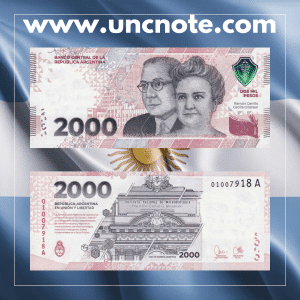
Portraits of Grierson and Carrillo, precursors in the development of medicine in Argentina
Script: Latin
Lettering:
BANCO CENTRAL DE LA REPÚBLICA ARGENTINA
DOS MIL
PESOS
Ramón Carrillo
Cecilia Grierson
Translation:
CENTRAL BANK OF THE ARGENTINE REPUBLIC
TWO THOUSAND
PESOS
Ramon Carrillo
Cecilia Crierson
Reverse
National Institute of Microbiology Dr. Carlos G. Malbrán
Script: Latin
Lettering:
REPÚBLICA ARGENTINA
en unión y libertad
La Administración Nacional de Laboratorios
e Instituto de Salud “Dr. Carlos G. Malbran”
Es un Organismo Público descentralizado,
de referencia nacional y regional en
materia sanitaria, cientifico-tenológica,
docencia e investidación, pilares
fundamentales de la Salud Pública
Translation:
ARGENTINIAN REPUBLIC
in union and freedom
The National Administration of Laboratories
and Institute of Health “Dr. Carlos G. Malbran”
It is a decentralized Public Organism,
of national and regional reference in
health, scientific-technological,
teaching and research, pillars
Fundamentals of Public Health
Watermark
Portraits of Grierson and Carrillo.

© Thuri
Signatures
| Cecilia Moreau (CM) | President H. C. Deputies |  |
| Miguel Angel Pesce (MAP) | President B. C. R. A. |  |
Printer
Casa de Moneda, Argentina
Comments
This banknote was designed as a tribute to Public Health, to the development of science and medicine in Argentina.
Cecilia Grierson was born in Buenos Aires on November 22, 1859 and died in the same city on April 10, 1934. She was the first doctor in Argentina, graduating in 1889 from the Faculty of Medicine of the University of Buenos Aires. Grierson practiced as an obstetrician and kinesiologist, but she was never able to work as a surgeon because of her status as a woman, despite having the qualifying title of the specialty. From a young age she also dedicated herself to teaching, a task that she never abandoned. At the same time, she tirelessly fought for women’s rights.
Grierson created the First Nursing School in Latin America with a formal curriculum, she was also the founder of the Argentine Medical Association. She also pioneered the idea of opening first aid rooms in different towns to help with primary care for the sick. She played a key role during the cholera epidemic that affected the City of Buenos Aires in 1886.
Ramón Carillo was born on March 7, 1906 in Santiago del Estero and died on December 20, 1956 in the city of Belén, in Brazil. He was a neurosurgeon, neurologist, sanitary doctor and the first Minister of Health of the Nation.
He graduated with a Medal of Honor from the Faculty of Medicine of the University of Buenos Aires. He was tenured professor of the Chair of Neurosurgery and abandoned his brilliant career as a neurologist to dedicate himself to the development of social medicine.
Carrillo made a great transformation in the public health of our country from a social conception of medicine. During his tenure as Minister of Public Health, which lasted eight years between 1946 and 1954, a significant number of public hospitals were created and massive vaccination campaigns were carried out, making the use of vaccination certificates compulsory for schools. He eradicated endemic diseases such as malaria in 2 years. He ended epidemics like typhus and brucellosis, and drastically reduced the infant mortality rate. He promoted the incorporation of the health train that traveled throughout the country for 4 months of the year doing clinical analysis, x-rays, medical and dental care.
The National Administration of Laboratories and the Dr. Carlos Malbrán Health Institute is a decentralized public body whose fundamental mission is to participate in scientific and technical policies related to health aspects. It was founded in 1893 with the aim of producing biological products to treat infectious diseases. The institution adopted the name of the famous doctor in 1941.
Important scientists such as Nobel laureates Bernardo Houssay and César Milstein worked at the Malbrán.
Features
| Issuer | Argentina |
|---|---|
| Issuing bank | Central Bank of the Argentine Republic (Banco Central de la República Argentina) |
| Ruling authority | Federal Republic (1861-date) |
| Type | Circulating commemorative banknotes |
| Year | 2023 |
| Value | 2000 Pesos 2000 ARS = GBP 1.22 |
| Currency | Peso convertible (1992-date) |
| Composition | Paper (90 g/m2 cotton) |
| Size | 155 × 65 mm |
| Shape | Rectangular |
| Technique | Intaglio, Offset |