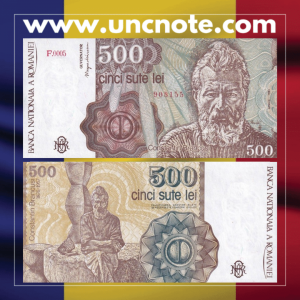
Romania 500 Lei Constantin Brâncuși 1991 Pick 98b UNC Banknote
The Romania 500 Lei 1991 Pick 98b is an important early banknote from Romania’s transition following the fall of the communist regime.
Issued by the Banca Națională a României (National Bank of Romania), the note celebrates Constantin Brâncuși (1876–1957), the Romanian-born sculptor whose radically simplified forms helped shape the development of modern sculpture.
The banknote is especially appealing because its design goes beyond simply depicting the artist: it incorporates imagery connected with Brâncuși’s own sculptures, turning the note into a miniature tribute to Romanian modern art.
Historical Background
The banknote appeared during a period of profound change in Romania.
The communist government of Nicolae Ceaușescu had collapsed in December 1989, and the country was beginning its transition toward a new political and economic system.
Romania’s banknotes consequently underwent major changes. Historical personalities and cultural figures became increasingly prominent in the country’s currency designs.
The selection of Constantin Brâncuși for the 500 Lei denomination reflected this renewed emphasis on internationally recognised figures from Romanian culture.
Technical Specifications
- Country: Romania
- Denomination: 500 Lei
- Year: 1991
- Pick Number: P-98b
- Condition: Uncirculated (UNC)
- Issuer: Banca Națională a României
- Currency: Romanian Leu (ROL)
- Material: Paper
- Dominant Colours: Blue, violet and multicolour
- Portrait: Constantin Brâncuși
- Theme: Romanian art and sculpture
- Type: Standard circulation banknote
- Status: Withdrawn currency
Obverse
The obverse is dominated by a portrait of Constantin Brâncuși and includes:
- Portrait of Constantin Brâncuși
- His name and lifespan 1876–1957
- 500 Lei denomination
- Banca Națională a României inscription
- Romanian Coat of Arms
- Serial numbers
- Intricate geometric and ornamental patterns
- Artistic imagery associated with Brâncuși’s work
The portrait gives the banknote a particularly distinctive appearance and makes the subject immediately recognisable to collectors of art-related currency.
Reverse
The reverse continues the Brâncuși theme with imagery inspired by his artistic legacy.
Most notably, the design references the monumental ensemble created by Brâncuși at Târgu Jiu, one of the most important collections of his work in Romania.
The ensemble includes three celebrated works:
The Endless Column (Coloana Infinitului), The Gate of the Kiss (Poarta Sărutului), and The Table of Silence (Masa Tăcerii).
Brâncuși created the ensemble as a memorial to Romanian soldiers who died during the First World War.
Who Was Constantin Brâncuși?
Constantin Brâncuși was born in Hobița, Romania, in 1876.
After studying art in Romania, he moved to Paris in 1904, where he became part of the rapidly developing European avant-garde.
Rather than reproducing his subjects realistically, Brâncuși progressively reduced human beings, animals and objects to elegant, simplified forms.
Among his best-known works are:
- Bird in Space
- The Kiss
- Sleeping Muse
- Mademoiselle Pogany
- The Endless Column
His work had a major influence on 20th-century sculpture and helped redefine the relationship between representation, abstraction and form.
Brâncuși and the Endless Column
One of the most recognisable works associated with Brâncuși is the Endless Column, completed at Târgu Jiu in the 1930s.
The monument consists of repeated geometric modules rising vertically into the sky, creating the visual impression that the column could continue indefinitely.
Together with the Gate of the Kiss and Table of Silence, it forms Brâncuși’s monumental ensemble at Târgu Jiu.
The ensemble was created to commemorate Romanian soldiers who defended the city during the First World War, adding an important historical dimension to works now primarily celebrated for their artistic significance.
Security Features
The 500 Lei incorporates security elements typical of Romanian banknotes of the early 1990s, including:
- Watermark
- Embedded security thread
- Fine-line guilloché patterns
- Detailed engraved printing
- Microprinted elements
- Serial numbering
- Multicoloured underprint
- Complex geometric designs
These features distinguish the early paper Lei from Romania’s later generation of sophisticated polymer banknotes.
Why Add This Banknote to Your Collection?
The Romania 500 Lei Constantin Brâncuși 1991 Pick 98b UNC banknote combines monetary history with one of the most internationally significant Romanian artists.
It is particularly suitable for collectors of Romanian banknotes, Eastern European currency, artists on banknotes, modern sculpture, post-communist issues and historical UNC world paper money.