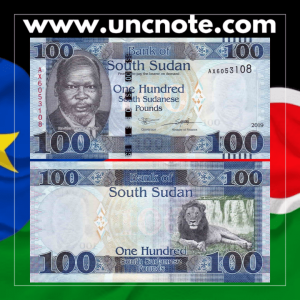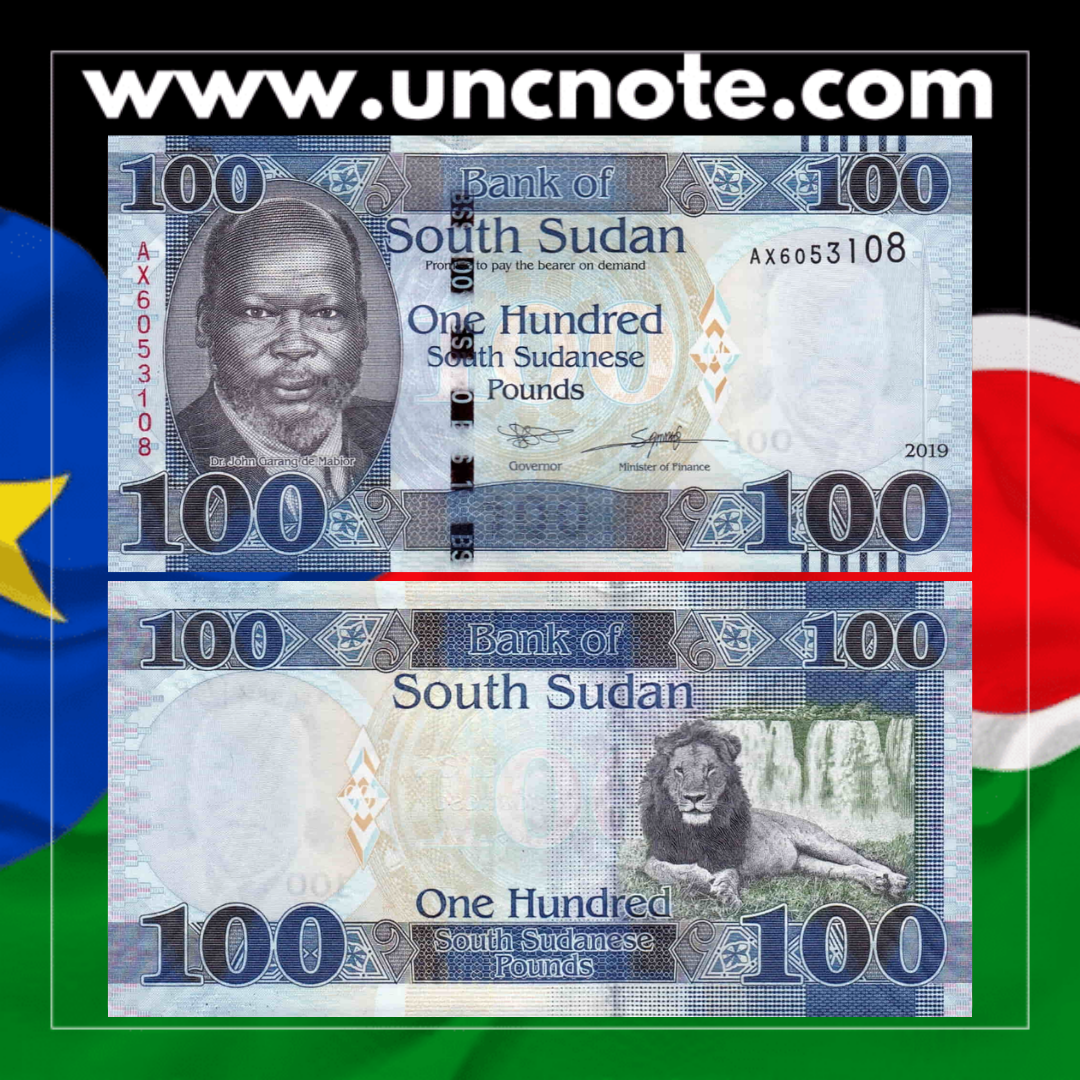
South Sudan 100 Pounds John Garang de Mabior 2019 Pick 15d UNC Banknote
The South Sudan 100 Pounds 2019 Pick 15d is a modern African banknote featuring Dr. John Garang de Mabior (1945–2005), one of the most influential figures in South Sudan’s history.
Issued by the Bank of South Sudan, this denomination belongs to the national currency introduced following the country’s independence in July 2011.
South Sudan became the world’s youngest internationally recognised sovereign state when it separated from Sudan on 9 July 2011.
The introduction of the South Sudanese Pound was an important symbol of the new country’s political sovereignty and economic independence.
The 100 Pounds denomination, featuring the portrait of John Garang, represents both South Sudan’s national identity and its modern monetary development.
Preserved in uncirculated condition, this 2019 issue is an attractive addition to collections of African paper money and contemporary world currencies.
Historical Background
South Sudan’s history is closely connected with the political developments and conflicts that shaped Sudan during the twentieth and early twenty-first centuries.
Following decades of civil war, the Comprehensive Peace Agreement of 2005 established a framework for peace between the Sudanese government and the Sudan People’s Liberation Movement.
The agreement provided for a referendum on self-determination.
In January 2011, voters in Southern Sudan overwhelmingly supported independence.
On 9 July 2011, the Republic of South Sudan officially became an independent nation.
Shortly afterwards, the country introduced its own currency, the South Sudanese Pound (SSP), replacing the Sudanese Pound.
The 100 Pounds 2019 banknote belongs to the early years of South Sudan’s independent monetary history.
Banknote Specifications
| Feature | Details |
|---|---|
| Country | South Sudan |
| Issuing authority | Bank of South Sudan |
| Denomination | 100 Pounds |
| Year | 2019 |
| Catalogue reference supplied | Pick 15d |
| Currency | South Sudanese Pound (SSP) |
| Condition | Uncirculated (UNC) |
| Material | Paper |
| Type | Circulation banknote |
| Main portrait | Dr. John Garang de Mabior |
| Currency introduced | 2011 |
| Region | East Africa |
Obverse
The obverse features a portrait of Dr. John Garang de Mabior, one of the central figures in South Sudan’s struggle for self-determination.
Garang was a political leader, military commander and founder of the Sudan People’s Liberation Movement (SPLM).
His portrait appears on South Sudanese banknotes as a tribute to his historical importance and his role in the peace process that ultimately led to independence.
The design also includes the denomination of 100 South Sudanese Pounds, official inscriptions and security elements.
The precise signature combination and security features of the Pick 15d variety should be confirmed against the physical banknote.
Reverse
The reverse of the South Sudanese 100 Pounds banknote features imagery associated with the country’s natural heritage and national identity.
The denomination is associated with a lion, one of Africa’s most recognisable wild animals.
The lion symbolises strength and forms part of the rich wildlife heritage of the African continent.
South Sudan is home to extensive savannas, wetlands and wildlife habitats, including the internationally important Sudd wetlands.
The country’s natural landscapes provide an important part of its geographical and cultural identity.
John Garang de Mabior (1945–2005)

John Garang de Mabior was born on 23 June 1945 in what is now South Sudan.
He became a military officer, political leader and one of the most influential figures in the Sudanese peace process.
Garang founded and led the Sudan People’s Liberation Movement and its armed wing during the Second Sudanese Civil War.
He advocated political reform and played a central role in negotiations that resulted in the Comprehensive Peace Agreement of January 2005.
Following the agreement, Garang became First Vice President of Sudan and President of the autonomous Government of Southern Sudan.
However, he died in a helicopter crash on 30 July 2005, several years before South Sudan achieved independence.
Although he did not live to see the creation of the independent republic, his legacy remains closely associated with the country’s political history.
His portrait was selected for South Sudan’s national banknotes, making him one of the most recognisable figures in the country’s currency designs.
South Sudan’s Independence in 2011
South Sudan officially became independent on 9 July 2011, following a referendum held earlier that year.
The country was admitted to the United Nations on 14 July 2011, becoming its 193rd member state.
Independence marked the culmination of decades of political negotiations and conflict.
The creation of a national currency was an important part of establishing the institutions of the new republic.
The South Sudanese Pound was introduced on 18 July 2011, only nine days after independence.
Banknotes featuring John Garang became an important symbol of the new nation’s identity.
The South Sudanese Pound
The South Sudanese Pound (SSP) is the official currency of the Republic of South Sudan.
It was introduced in July 2011, replacing the Sudanese Pound at par during the transition to independence.
One South Sudanese Pound is divided into 100 Piastres.
The currency is issued by the Bank of South Sudan.
| Year | Monetary development |
|---|---|
| 2011 | South Sudan becomes independent |
| 2011 | South Sudanese Pound introduced |
| 2019 | Year of the 100 Pounds issue offered here |
| 2021 | Introduction of a 1000 Pounds banknote |
| 2020s | Continued changes to the country’s currency system |
South Sudanese banknotes are particularly interesting because they document the monetary history of a country established in the twenty-first century.
The Bank of South Sudan
The Bank of South Sudan serves as the country’s central bank.
Established following independence in 2011, it is responsible for issuing the national currency, implementing monetary policy and overseeing the banking system.
The introduction of the South Sudanese Pound was one of the institution’s earliest and most important responsibilities.
South Sudan’s banknotes incorporate portraits and imagery reflecting the country’s history, cultural heritage and natural environment.
The 100 Pounds denomination is an example of this national currency tradition.
South Sudan’s Wildlife and Natural Heritage
South Sudan contains extensive natural habitats, including tropical forests, grasslands, savannas and wetlands.
One of its most important geographical features is the Sudd, a vast wetland formed by the White Nile.
The country supports diverse wildlife, including antelopes, elephants, giraffes and numerous bird species.
Wildlife imagery is a prominent feature of South Sudanese banknote designs.
These subjects help represent the country’s natural environment and distinguish its currency from that of neighbouring countries.
The lion associated with the 100 Pounds denomination is a particularly recognisable symbol of African wildlife.
South Sudan in 2019
The year 2019 was significant in South Sudan’s modern history.
The country was continuing efforts to implement the Revitalised Agreement on the Resolution of the Conflict in the Republic of South Sudan, signed in September 2018.
The agreement sought to address the civil conflict that had begun in December 2013.
Political negotiations and efforts to establish a transitional government continued throughout 2019.
The country’s economy also faced significant challenges, including inflation, dependence on oil revenues and disruption caused by conflict.
Banknotes issued during this period provide collectors with a tangible connection to the early history of independent South Sudan.
Collecting South Sudanese Banknotes
South Sudan is a particularly interesting country for modern world banknote collectors because its national currency was introduced only in 2011.
The country’s banknotes offer an opportunity to collect the currency of one of the newest sovereign states.
Collectors can organise South Sudanese paper money by denomination, issue year, catalogue reference or design variety.
The 100 Pounds Pick 15d can complement other denominations featuring John Garang, including 5, 10, 20 and 50 Pounds.
Together, these banknotes illustrate the development of South Sudan’s national currency following independence.
Why Add This Banknote to Your Collection?
The South Sudan 100 Pounds 2019 Pick 15d UNC Banknote offers several attractive collecting features:
-
John Garang portrait: honours an influential figure in South Sudan’s history.
-
Young independent nation: represents the national currency introduced following independence in 2011.
-
2019 issue: associated with the country’s early years of statehood.
-
African wildlife: features imagery reflecting South Sudan’s natural heritage.
-
Uncirculated condition: preserved without normal circulation wear.
-
Modern monetary history: an interesting addition to collections of recently established national currencies.