
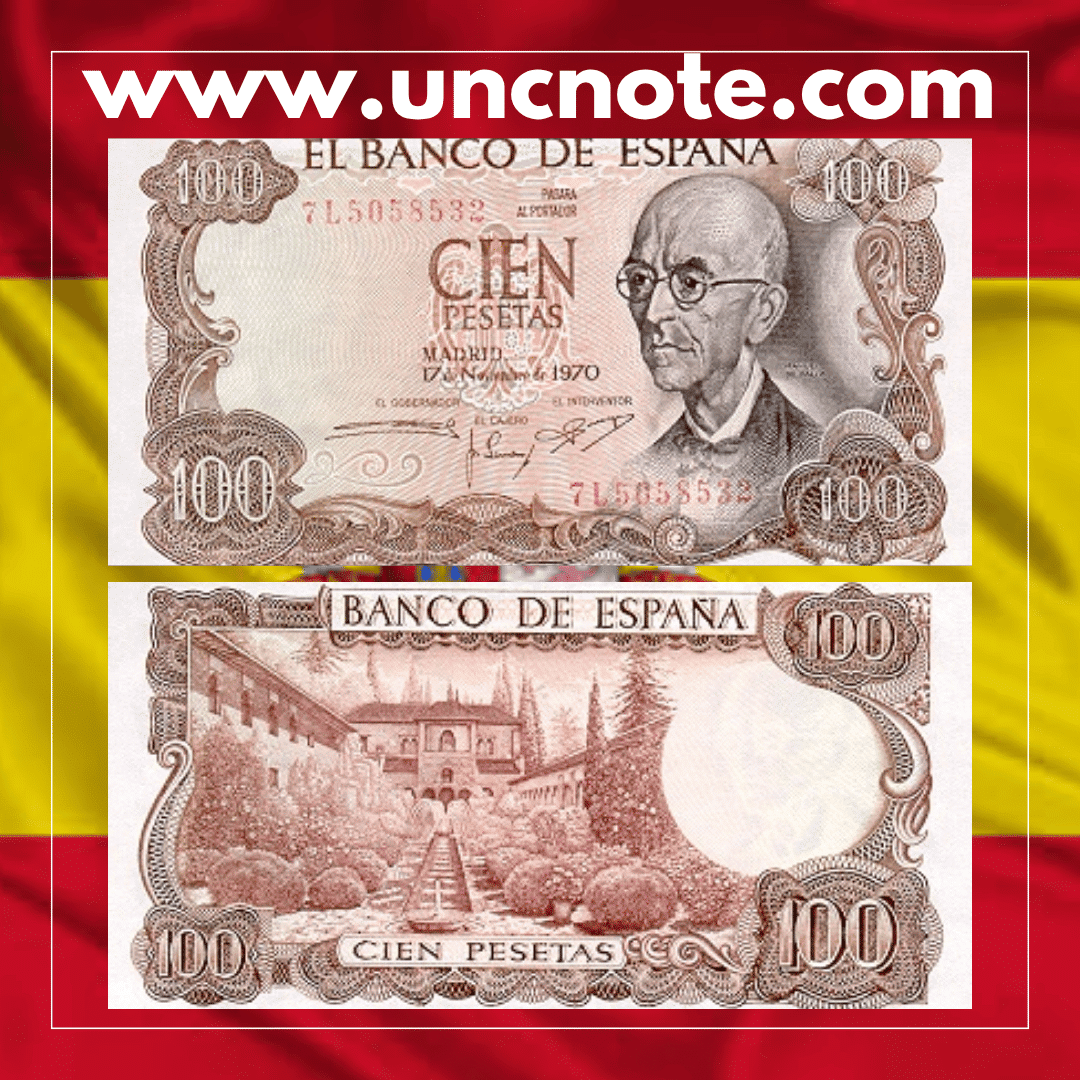
The 100 Pesetas 1970 (dated 1970, issued 1974) banknote was released by the Banco de España in the last years of Franco’s regime.
The obverse features a portrait of Manuel de Falla (1876–1946), one of Spain’s most renowned composers, known for works such as El amor brujo and La vida breve.
The reverse shows the Patio de los Arrayanes (Court of the Myrtles) in the Alhambra of Granada, a masterpiece of Nasrid architecture and one of Spain’s most famous monuments.
The watermark depicts the head of Manuel de Falla.
Dimensions: 146 × 75 mm. Printed by the Fábrica Nacional de Moneda y Timbre.
Obverse
Brown and black print; red serial number.
Bust of Spanish composer Manuel de Falla facing left inspired in the portrait made by Ignacio Zuloaga. Coat of arms of Spain in background and geometric designs.
Script: Latin
Lettering:
100
EL BANCO DE ESPAÑA
PAGARA AL PORTADOR CIEN PESETAS
MADRID, 17 de Noviembre de 1970
MANUEL DE FALLA
EL GOBERNADOR. EL INTERVENTOR. EL CAJERO
FCA NAL DE MONEDA Y TIMBRE
Translation:
The Bank of Spain
Will pay the bearer One hundred Pesetas
Madrid, November 17, 1970
The Governor. The Comptroller. The Cashier
Engraver: Antonio Manso Fernández
Designer: José Antonio Prieto
Reverse
Brown and black print.
“Patio de la Acequia” of the Generalife in Granada. Geometric designs.
Script: Latin
Lettering:
100
BANCO DE ESPAÑA
CIEN PESETAS
Translation:
Bank of Spain
One Hundred Pesetas
Engraver: Daniel Carande Boto
Designer: Mateo García Navarro
Watermark
Manuel de Falla’s head
Signatures
| Luis Coronel de Palma (LCP) | Governor |  |
| José Gallego Adrados (JGA) | Comptroller |  |
| Joaquín Serrano García (JSG) | Cashier |  |
Printer
Fábrica Nacional de Moneda y Timbre, Spain
Comments
Series: Without series and from series A to series 7W.
Put in circulation on March 20, 1974.
Manuel de Falla y Matheu (23 November 1876 – 14 November 1946) was a Spanish composer and pianist. Along with Isaac Albéniz, Francisco Tárrega, and Enrique Granados, he was one of Spain’s most important musicians of the first half of the 20th century. He has a claim to being Spain’s greatest composer of the 20th century, although the number of pieces he composed was relatively modest.
The “Patio de la Acequia” (48.70 meters by 12.80 meters) is the most important part of the Generalife, although its appearance has changed since Arab times, both in its construction and in its landscaping. It has a channel that divides the patio longitudinally, which carries the waters of the Alhambra irrigation canal, and which is surrounded by a set of small fountains, and which ends at its ends in two stone cups. The rest of the patio is occupied by different plant species that have varied according to the tastes of the time. Currently we find hedges of myrtle, orange trees, cypresses and rose bushes.
Features
| Issuer | Spain |
|---|---|
| Issuing entity | Bank of Spain (Banco de España) |
| Ruling authority | Francisco Franco (1936-1975) |
| Type | Standard circulation banknotes |
| Year | 1970 |
| Value | 100 Pesetas (100 ESP) |
| Currency | Peseta (1868-2001) |
| Composition | Paper |
| Size | 135 × 77 mm |
| Shape | Rectangular |
| Technique | Intaglio, Lithography |
| Demonetized | Yes |


