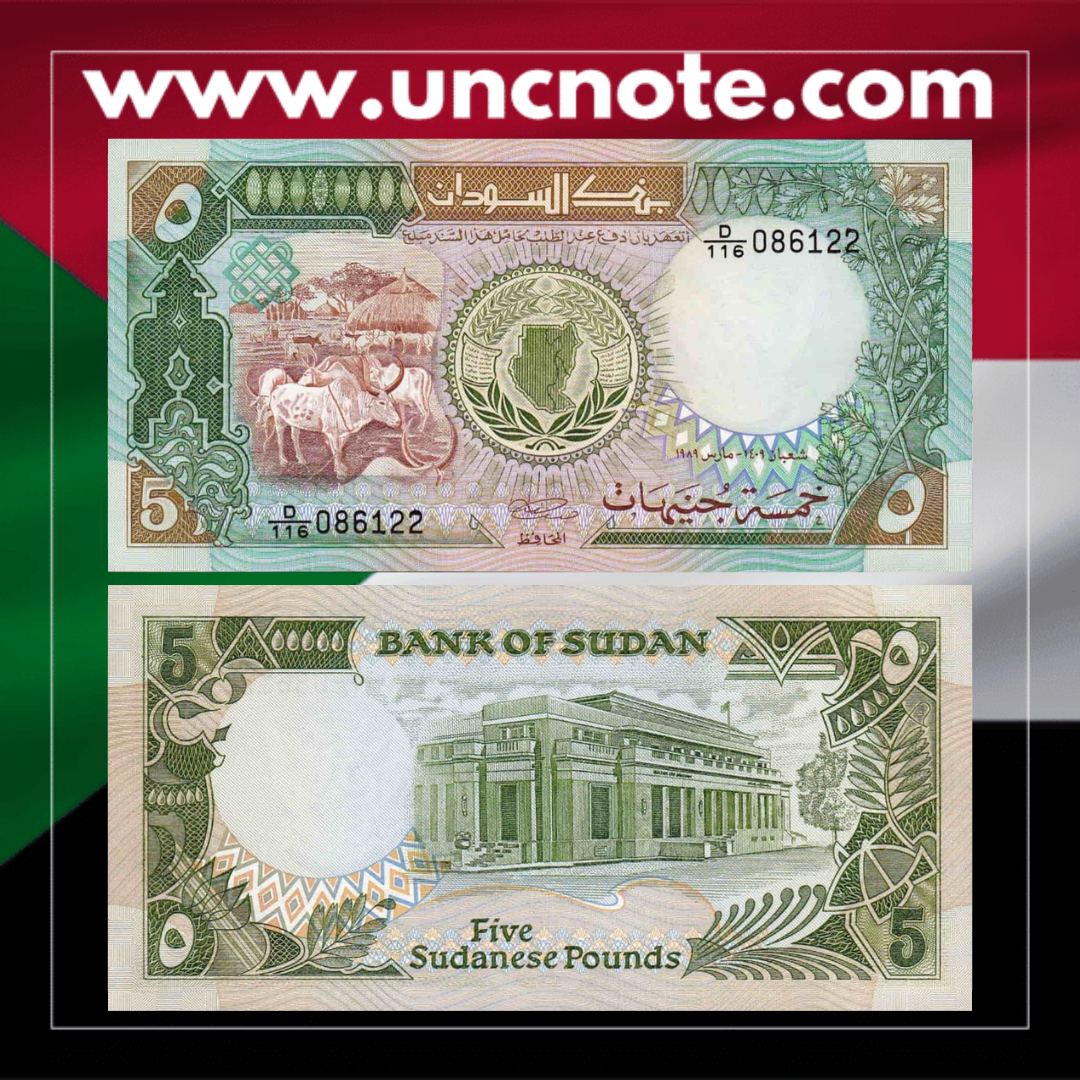
Sudan 5 Pounds 1989 Pick 40b UNC Banknote
The Sudan 5 Pounds 1989 Pick 40b is a historical banknote from the final years of Sudan’s original Pound currency system.
Issued by the Bank of Sudan, this denomination represents an important period in the country’s monetary history, shortly before the introduction of the Sudanese Dinar in 1992.
The original Sudanese Pound was introduced following the country’s independence in 1956 and remained the official monetary unit for more than three decades.
Dating from 1989, this banknote provides collectors with a tangible connection to Sudan’s late twentieth-century economic and political history.
Preserved in uncirculated condition, it is an attractive addition to collections of historical African currencies and discontinued world banknotes.
Historical Background
Sudan gained independence on 1 January 1956, following the end of joint British-Egyptian administration.
The country subsequently introduced its own national currency, the Sudanese Pound, replacing the Egyptian Pound that had previously circulated.
During the following decades, Sudan experienced significant political and economic changes.
The late 1980s were particularly turbulent, with inflationary pressures, economic difficulties and political instability.
In 1989, a military coup brought Omar al-Bashir to power, beginning a period of government that would continue until 2019.
The 5 Pounds 1989 banknote belongs to this historically significant period.
Only three years later, in 1992, Sudan replaced the original Pound with the Sudanese Dinar.
Banknote Specifications
| Feature | Details |
|---|---|
| Country | Sudan |
| Issuing authority | Bank of Sudan |
| Denomination | 5 Pounds |
| Year | 1989 |
| Catalogue reference supplied | Pick 40b |
| Currency | Original Sudanese Pound |
| Condition | Uncirculated (UNC) |
| Material | Paper |
| Type | Circulation banknote |
| Historical period | Late original Sudanese Pound era |
| Currency period | 1956–1992 |
| Region | Northeast Africa |
Obverse
The obverse features official imagery associated with Sudan’s national identity and cultural heritage.
Sudanese banknotes from the late twentieth century frequently incorporated decorative artwork reflecting the country’s architecture, agriculture, economic activities and historical traditions.
The design includes the denomination of 5 Pounds, together with inscriptions identifying the issuing authority.
The precise motifs, inscriptions and signature combination of the Pick 40b variety should be verified against the physical banknote before publication.
Reverse
The reverse continues the banknote’s national theme through imagery connected with Sudanese society and economic development.
Currency designs from this period provide an interesting visual record of the symbols and subjects selected to represent Sudan.
The exact reverse artwork of the 1989 Pick 40b variety should be confirmed against the physical specimen to ensure accurate catalogue identification.
The Original Sudanese Pound: 1956–1992
The Sudanese Pound was introduced in 1956, following Sudan’s independence.
It replaced the Egyptian Pound at par and became the country’s national monetary unit.
One Sudanese Pound was divided into 100 Piastres.
The currency remained in use throughout several decades of political and economic change.
During the 1970s and 1980s, Sudan experienced increasing economic difficulties, including inflation and pressure on the value of its currency.
In 1992, the original Sudanese Pound was replaced by the Sudanese Dinar at a conversion rate of:
1 Sudanese Dinar = 10 old Sudanese Pounds
Today, banknotes from the original Pound period are collected as examples of a discontinued monetary system.
Sudan’s Monetary History
Sudan’s currency has undergone several important transformations since independence.
| Year | Monetary development |
|---|---|
| 1956 | Original Sudanese Pound introduced |
| 1989 | Year of the 5 Pounds banknote offered here |
| 1992 | Sudanese Dinar replaced the original Pound |
| 2007 | New Sudanese Pound replaced the Dinar |
| 2011 | Revised Sudanese currency introduced following South Sudan’s independence |
These changes make Sudan particularly interesting for collectors studying monetary reforms and historical currencies.
The 5 Pounds 1989 represents the first of these major modern currency periods.
The Bank of Sudan
The Bank of Sudan, established in 1960, serves as the country’s central banking institution.
Its responsibilities include issuing national currency, implementing monetary policy and regulating the banking system.
Throughout its history, the institution has overseen several changes to Sudan’s monetary system.
The transition from the original Pound to the Dinar in 1992 was one of the most significant reforms.
Banknotes issued before this change provide collectors with historical examples of Sudan’s earlier monetary structure.
Sudan in 1989
The year 1989 marked an important turning point in Sudan’s modern history.
The country faced significant economic difficulties, political instability and the continuing effects of civil conflict.
On 30 June 1989, a military coup led by Omar al-Bashir overthrew the civilian government of Prime Minister Sadiq al-Mahdi.
The subsequent political changes influenced Sudan’s development for the following three decades.
The 5 Pounds 1989 banknote provides a numismatic connection to this period.
For collectors interested in the relationship between political history and currency, banknotes from the late 1980s offer valuable historical context.
The 5 Pounds Denomination
The 5 Pounds denomination formed part of Sudan’s original currency system.
Banknotes of this value were used within the country’s everyday monetary structure before the introduction of the Dinar.
As inflation and changes in purchasing power affected Sudan’s economy, the monetary system gradually evolved.
The eventual replacement of the Pound in 1992 marked the end of an important chapter in Sudanese currency history.
For collectors, the 1989 5 Pounds is an interesting example of the country’s pre-Dinar banknotes.
Collecting Historical Sudanese Banknotes
Sudanese paper money offers collectors an opportunity to explore several distinct monetary periods.
A collection focused on the country’s currency history may include:
-
Original Sudanese Pound banknotes issued between 1956 and 1992.
-
Sudanese Dinar banknotes issued between 1992 and 2007.
-
Modern Sudanese Pound banknotes introduced from 2007 onwards.
The Sudan 5 Pounds 1989 Pick 40b is an attractive addition to the first period.
It can also complement later Sudanese Dinar denominations, including the 5 Dinars 1993 Pick 51 and 25 Dinars 1992 Pick 53a(3).
Together, these notes illustrate the evolution of Sudan’s monetary system across different decades.
Why Add This Banknote to Your Collection?
The Sudan 5 Pounds 1989 Pick 40b UNC Banknote offers several attractive collecting features:
-
Historical currency: represents Sudan’s original Pound monetary system.
-
Pre-Dinar issue: belongs to the period before the 1992 currency reform.
-
1989 date: associated with an important year in Sudan’s modern history.
-
Uncirculated condition: preserved without normal circulation wear.
-
African numismatics: an interesting addition to collections of Northeast African paper money.
-
Monetary history: complements Sudanese Dinar and modern Pound banknotes.