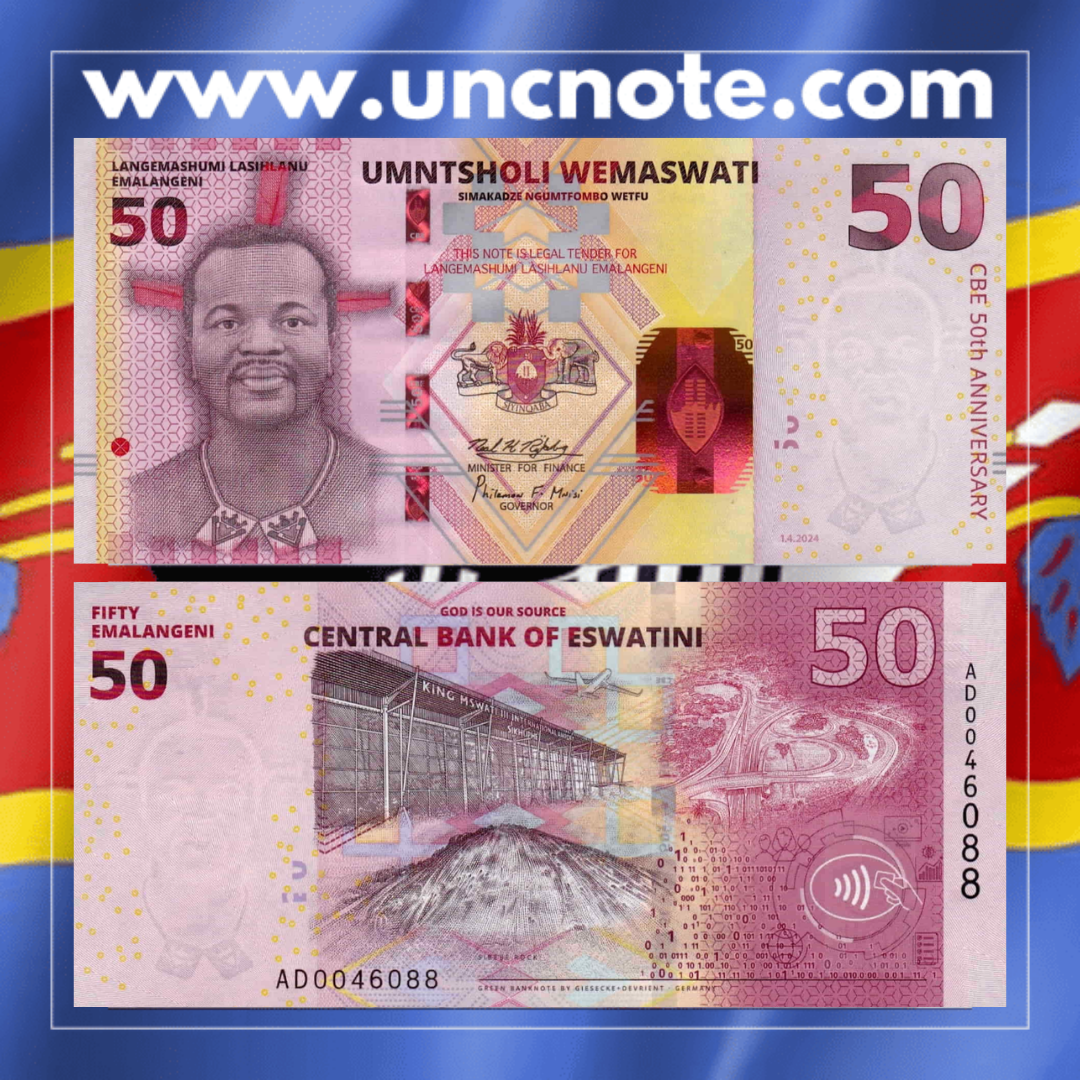
Swaziland 50 Emalangeni King Mswati III Commemorative 2024 Pick 46 UNC Banknote
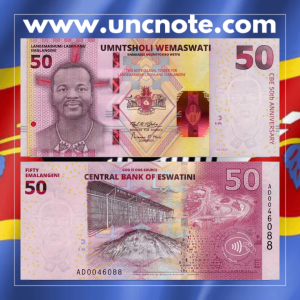
The Eswatini 50 Emalangeni 2024 Pick 46 is a commemorative banknote issued by the Central Bank of Eswatini, featuring King Mswati III, the reigning monarch of this Southern African kingdom.
The banknote represents the country’s royal heritage, national identity and modern monetary history.
Issued under the country’s current name, Eswatini, it also reflects the transition from the former international name of Swaziland.
Preserved in uncirculated condition, this commemorative issue is an appealing addition to collections of African paper money and banknotes featuring contemporary monarchs.
Historical Background
Eswatini, formerly known internationally as Swaziland, gained independence from the United Kingdom on 6 September 1968.
The country has maintained its monarchy throughout its post-independence history.
King Mswati III ascended to the throne in 1986, succeeding King Sobhuza II following a period of regency.
In April 2018, during celebrations marking 50 years of independence and his 50th birthday, King Mswati III announced that the country would officially be known as the Kingdom of Eswatini.
The name change reflected the country’s traditional siSwati identity.
The 2024 commemorative 50 Emalangeni banknote belongs to this modern period of Eswatini’s monetary and royal history.
Banknote Specifications
| Feature | Details |
|---|---|
| Country | Eswatini (formerly Swaziland) |
| Issuer | Central Bank of Eswatini |
| Denomination | 50 Emalangeni |
| Year | 2024 |
| Catalogue number | Pick 46 — supplier reference |
| Currency | Swazi Lilangeni (SZL) |
| Condition | Uncirculated (UNC) |
| Featured personality | King Mswati III |
| Type | Commemorative banknote |
| Material | To be confirmed |
| Region | Southern Africa |
Obverse
The obverse features a portrait of King Mswati III, reflecting the monarchy’s central position in Eswatini’s national identity.
The design incorporates the denomination of 50 Emalangeni, official inscriptions and decorative elements associated with the kingdom.
The portrait connects the banknote with Eswatini’s royal traditions and contemporary political history.
Reverse
The reverse incorporates imagery representing the Kingdom of Eswatini and its national heritage.
The composition complements the royal portrait on the obverse while displaying the denomination and identifying inscriptions.
The precise commemorative inscriptions and reverse imagery should be verified against the physical banknote.
Who Is King Mswati III?
King Mswati III, born on 19 April 1968, became King of Swaziland in 1986.
He is the son of King Sobhuza II, who ruled for much of the twentieth century.
Eswatini is one of the world’s remaining absolute monarchies, with the king exercising substantial constitutional and political authority.
During his reign, the country has undergone economic, social and political changes while maintaining many traditional royal institutions.
His portrait has appeared on multiple generations of Eswatini banknotes, making him a familiar figure in the country’s modern numismatic history.
The Kingdom of Eswatini
Eswatini is a landlocked country in Southern Africa, bordered by South Africa and Mozambique.
Despite its relatively small geographical size, the country has a distinctive cultural heritage rooted in Swazi traditions.
Important national ceremonies include the Umhlanga Reed Dance and Incwala, both closely associated with the monarchy and traditional cultural practices.
The country’s banknotes frequently reflect this royal and cultural identity.
The Swazi Lilangeni
The Lilangeni (SZL) is the official currency of Eswatini.
Its plural form is Emalangeni, which explains the denomination used on the banknote.
The currency was introduced in 1974, replacing the South African Rand as the country’s primary national currency.
However, the Lilangeni remains pegged to the South African Rand at a rate of 1 SZL = 1 ZAR through the Common Monetary Area arrangements.
South African Rand banknotes are also accepted as legal tender in Eswatini.
The Lilangeni is divided into 100 Cents.
Commemorative Banknotes and Royal Heritage
Commemorative banknotes are issued to recognise important historical events, anniversaries, institutions or national personalities.
They often differ from regular circulation issues through special inscriptions, distinctive designs or commemorative elements.
For collectors, these notes provide a direct connection to the events and personalities they celebrate.
The Eswatini 50 Emalangeni 2024 is particularly interesting for its association with King Mswati III and the country’s modern royal history.
Why Add This Banknote to Your Collection?
The Eswatini 50 Emalangeni King Mswati III Commemorative 2024 Pick 46 UNC Banknote combines several attractive collecting themes: African monarchies, royal portraits, commemorative currency, Southern African monetary history and modern world banknotes.
Its recent issue date and uncirculated condition make it suitable for collectors building contemporary African currency collections.
The banknote is also interesting for collectors documenting the country’s transition from the name Swaziland to Eswatini.