
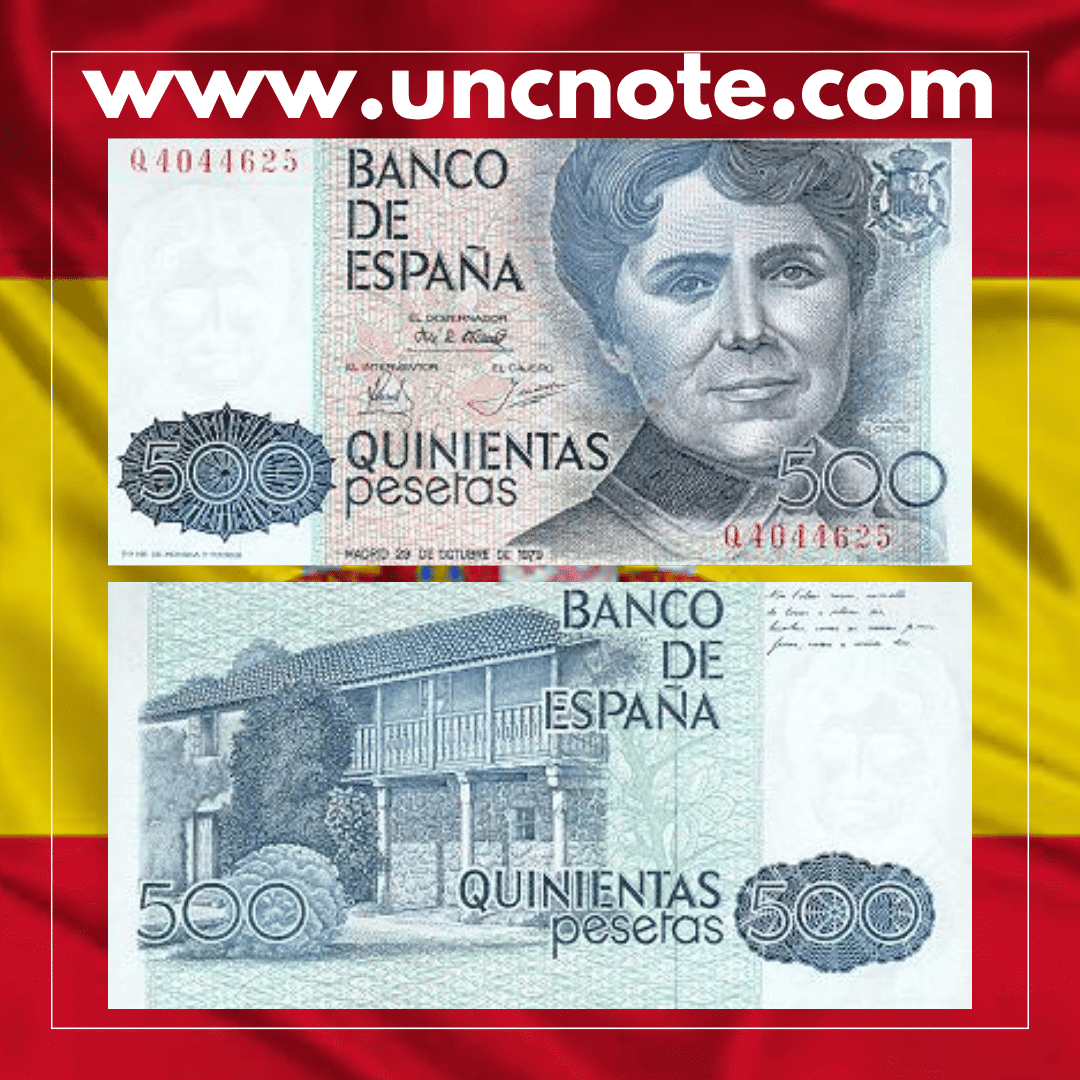
The 500 Pesetas 1979 (issued 1983) banknote was released by the Banco de España in the early 1980s.
The obverse features the portrait of Rosalía de Castro (1837–1885), one of Spain’s most important poets and novelists, recognized as the voice of Galician literature and Romanticism.
The reverse presents a view of Santiago de Compostela Cathedral, one of the most iconic monuments in Galicia and a symbol of Spanish cultural and religious heritage.
The watermark shows the head of Rosalía de Castro.
Dimensions: 147 × 80 mm. Printed by the Fábrica Nacional de Moneda y Timbre.
Obverse
Blue print; multicolor underprint; red serial number.
Bust of Spanish poet and novelist María Rosalía Rita de Castro and coat of arms of Spain on top right.
Script: Latin
Lettering:
500
BANCO DE ESPAÑA
QUINIENTAS pesetas
ROSALIA DE CASTRO
MADRID 23 DE OCTUBRE DE 1979
EL GOBERNADOR. EL INTERVENTOR. EL CAJERO
FCA NAL DE MONEDA Y TIMBRE
Translation:
Bank of Spain
Five hundred Pesetas
Madrid October 23, 1979
The Governor. The Comptroller. The Cashier
Engraver: Pablo Sampedro Molero
Reverse
Blue print; green and brown underprint.
House-Museum of Rosalía de Castro in Padrón (La Coruña). Rosalía’s autograph text: fragment of her poem “Follas Novas” in Galician language.
Script: Latin
Lettering:
500
BANCO DE ESPAÑA
QUINIENTAS pesetas
Non Follas novas, ramallo de toxos e silvas sós,
hirtas, como as miñas penas, feras, como a miña dor.
Translation:
Bank of Spain
Five hundred pesetas
No, new leaves, bouquet of gorse and brambles you are,
barren as my sorrows, fierce as my pain.
Engraver: Antonio Sánchez Gutiérrez
Watermark
Head of Rosalía de Castro.
Signatures
| José Ramón Álvarez Rendueles (JRÁR) | Governor |  |
| Miguel Palazuelo García (MPG) | Comptroller |  |
| Jesús Urdiola Salvador (JUS) | Cashier |  |
Printer
Fábrica Nacional de Moneda y Timbre, Spain
Comments
Series: Without series and from series A to series 1S.
María Rosalía Rita de Castro (23 February 1837 – 15 July 1885), was a Galician poet and novelist, considered one of the most important figures of the 19th-century Spanish literature and modern lyricism. Widely regarded as the greatest Galician cultural icon, she was a leading figure in the emergence of the literary Galician language. Through her work, she projected multiple emotions, including the yearning for the celebration of Galician identity and culture, and female empowerment. She is credited with challenging the traditional female writer archetype.
The Casa Museo Rosalía de Castro, also called Casa da Matanza, is a house museum located in the house where Rosalía de Castro lived with her husband Manuel Murguía and the children of the family from 1883 until her death in 1885. It collects different editions of his works and various material of his, such as photographs or personal memories. On the second floor, recreate the atmosphere of the house in Rosalía’s time.
Features
| Issuer | Spain |
|---|---|
| Issuing entity | Bank of Spain (Banco de España) |
| King | Juan Carlos I (1975-2014) |
| Type | Standard circulation banknotes |
| Year | 1979 |
| Value | 500 Pesetas (500 ESP) |
| Currency | Peseta (1868-2001) |
| Composition | Paper |
| Size | 129 × 70 mm |
| Shape | Rectangular |
| Technique | Intaglio, Lithography |
| Demonetized | Yes |


