
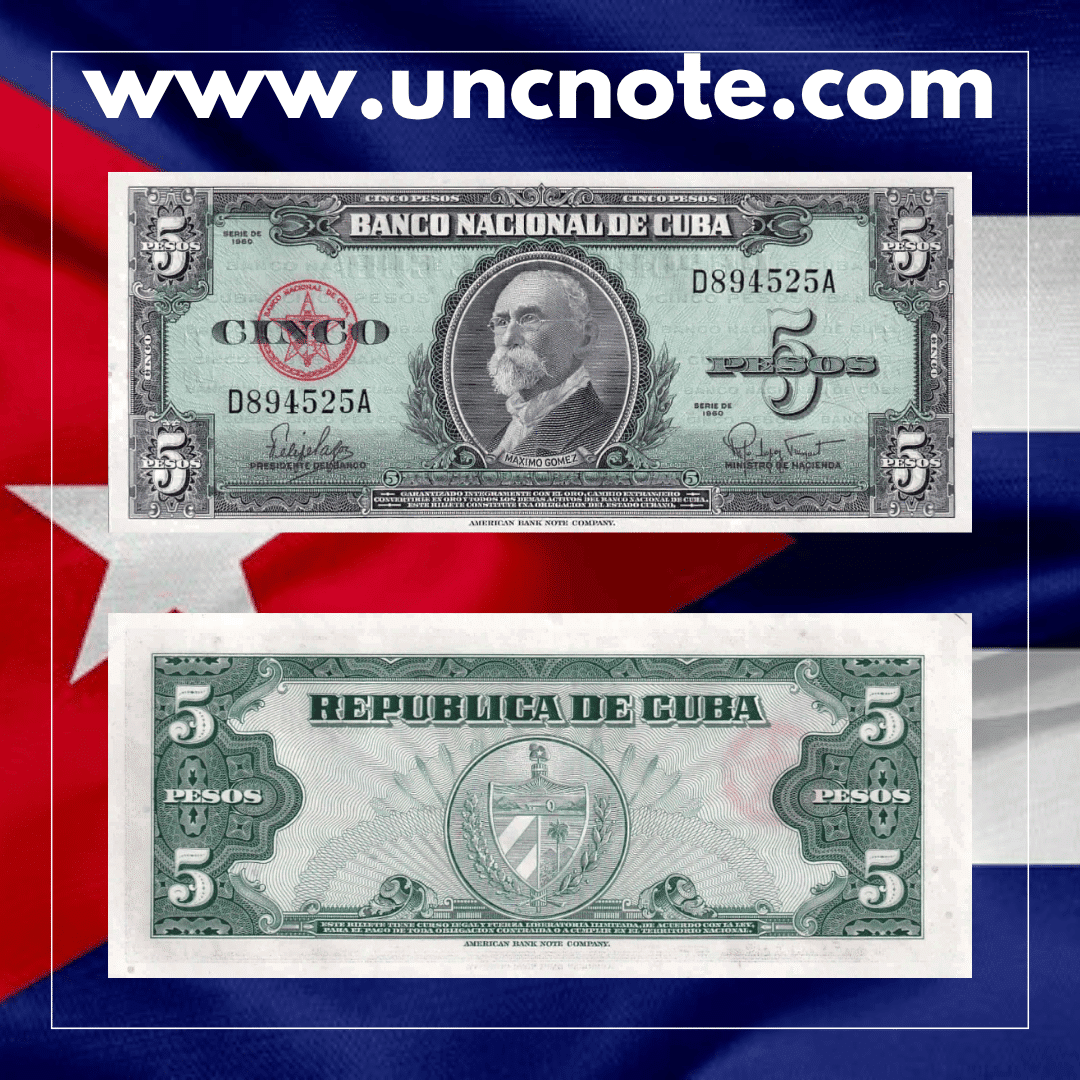
The 5 Pesos 1960 banknote was issued by the Banco Nacional de Cuba during the early years of the Cuban Revolution, reflecting the transitional period of Cuban currency.
The obverse features the portrait of José Martí (1853–1895), the national hero and revolutionary leader, surrounded by intricate guilloché patterns and the denomination in numerals and words.
The reverse depicts Cuban national symbols and allegorical motifs representing liberty, agriculture, and progress.
Printed on cotton-based paper, the note includes a watermark, subtle security threads, and fine-line background patterns.
Dimensions: 156 × 65 mm.
Obverse
Portrait of Maximo Gomez in oval frame, at center.
Color: black and green.
Serial: black
on left, red seal of the National Bank of Cuba.
Script: Latin
Lettering:
5 PESOS 5 PESOS
BANCO NACIONAL DE CUBA
CINCO
5 PESOS
MAXIMO GOMEZ
GARANTIZADO INTEGRAMENTE CON EL ORO, CAMBIO EXTRANJERO
CONVERTIBLE EN ORO Y TODOS LOS DEMÁS ACTIVOS DEL BANCO NACIONAL DE CUBA.
ESTE BILLETE CONSTITUYE UNA OBLIGACIÓN DEL ESTADO CUBANO.
Translation:
5 Pesos 5 Pesos
National Bank of Cuba
Five
5 Pesos
Maximo Gomez
Fully Guaranteed with the gold, foreign exchange.
Convertible into gold and all the other assets of the National Bank of Cuba
This note constitutes an obligation of the Cuban State.
Reverse
Cuban coat of arms at center, in circle frame. Country name on top; face value in numbers and letters on both ends.
Script: Latin
Lettering:
REPUBLICA DE CUBA
5 5
PESOS PESOS
5 5
ESTE BILLETE TIENE CURSO LEGAL Y FUERZA LIBERATORIA ILIMITADA, DE ACUERDO CON LA LEY, PARA EL PAGO DE TODA OBLIGACION CONTRAIDA O ACUMPLIR EN EL TERRITORIO NACIONAL.
Translation:
Republic of Cuba
5 5
Pesos Pesos
5 5
This note is legal tender and has unlimited liberatory force, in accordance with the law,
for payment of all obligations, contracted or to be fulfilled, on the whole national territory
Printer
American Banknote Corporation (American Bank Note Company), United States (1795-date)
Comments
At 16 years old, joined Dominican Army to fight against Haitian occupation, and when Santo Domingo (the island name) re-joined Spain as colony, he passed to Spanish Army. Fought against Revolutionaries who wanted to regain their independence from Spain, and after victory of independents, moved to Cuba.At Cuba suffered the oppression of Spanish Army, so joined to Cuban revolutionaries. Owing to his knowledge of tactics and strategies very soon was named Major General by President Céspedes.
He is famous for having commanded the first “Carga al Machete” (Machete attack).
Was named War Secretary, and General Chief (that he refused), and owing to his sight of problems within the Cuban forces, decided to leave and went to Jamaica. Later resided at Honduras, where had high positions in the local army and government, and then went to Costa Rica, where took contact with Antonio Maceo, joined Martí cause, and on 1895 signed the Montecristi Manifesto.
Features
| Issuer | Cuba |
|---|---|
| Issuing bank | National Bank of Cuba |
| Period | Second Republic (1959-date) |
| Type | Standard circulation banknotes |
| Year | 1960 |
| Value | 5 Pesos (5 CUP) |
| Currency | Cuban Peso (moneda nacional, 1914-date) |
| Composition | Paper |
| Size | 156 × 67 mm |
| Shape | Rectangular |
| Demonetized | 4 August 1961 |


