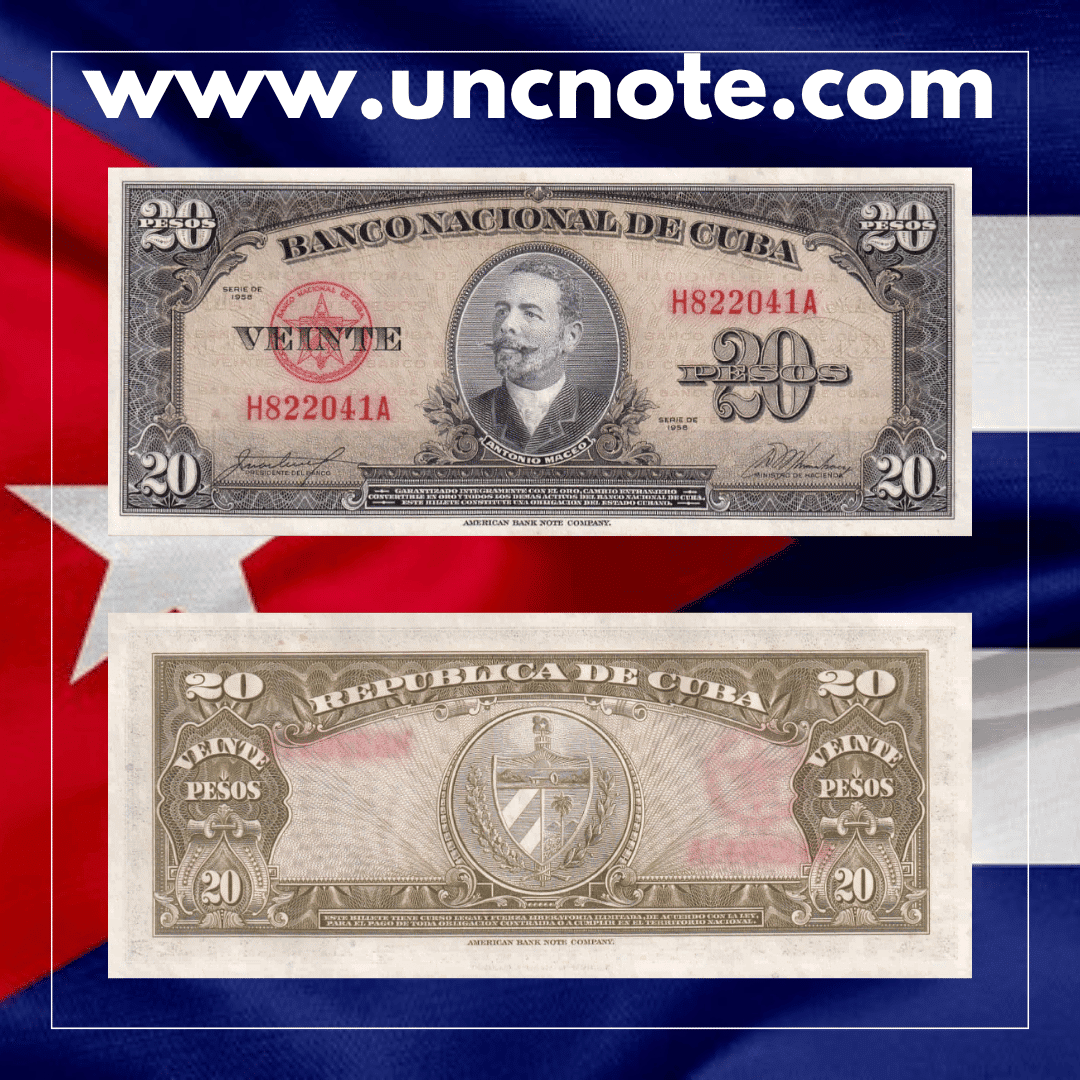
The 20 Pesos 1958 banknote was issued by the Banco Nacional de Cuba during the pre-revolutionary period, reflecting the classical design style of mid-20th century Cuban currency.
The obverse features a portrait of José Martí (1853–1895), Cuba’s national hero and revolutionary leader, framed by intricate guilloché patterns and the denomination in numerals and words.
The reverse depicts allegorical motifs symbolizing Cuban prosperity, agriculture, and liberty, with elaborate ornamental designs.
Printed on cotton-based paper, the banknote includes a watermark, subtle security threads, and fine-line patterns.
Dimensions: 156 × 65 mm.
Obverse
Portrait of Antonio Maceo in oval frame, at center.
Color: black and olive green.
Serial: red (1949 & 1958); black (1960).
on left, red seal of the National Bank of Cuba.
Script: Latin
Lettering:
20 PESOS 20 PESOS
BANCO NACIONAL DE CUBA
VEINTE
20 PESOS
ANTONIO MACEO
GARANTIZADO INTEGRAMENTE CON EL ORO, CAMBIO EXTRANJERO
CONVERTIBLE EN ORO Y TODOS LOS DEMÁS ACTIVOS DEL BANCO NACIONAL DE CUBA.
ESTE BILLETE CONSTITUYE UNA OBLIGACIÓN DEL ESTADO CUBANO.
Translation:
20 Pesos 20 Pesos
National Bank of Cuba
Twenty
20 Pesos
Antonio Maceo
Fully Guaranteed with the gold, foreign exchange.
Convertible into gold and all the other assets of the National Bank of Cuba
This note constitutes an obligation of the Cuban State.
Reverse
Coat of arms at center, in oval frame. Denomination on left and right. Country name on top.
Script: Latin
Lettering:
REPUBLICA DE CUBA
VEINTE VEINTE
PESOS PESOS
ESTE BILLETE TIENE CURSO LEGAL Y FUERZA LIBERATORIA ILIMITADA, DE ACUERDO CON LA LEY, PARA EL PAGO DE TODA OBLIGACION CONTRAIDA O ACUMPLIR EN EL TERRITORIO NACIONAL.
Translation:
Republic of Cuba
Twenty Twenty
Pesos Pesos
This note is legal tender and has unlimited liberatory force, in accordance with the law,
for payment of all obligations, contracted or to be fulfilled, on the whole national territory
Signatures
| Felipe Pazos Roque (FPR) | President of National Bank of Cuba |  |
| Antonio Prío Socarrás (APS) | Minister of Finance |  |
| Joaquín Martínez Sáenz (JMS) | President of National Bank of Cuba |  |
| Alejandro Herrera Arango (AHA) | Minister of Finance |  |
| Ernesto “Che” Guevara (E”G) | President of National Bank of Cuba | %20Guevara.jpg) |
| Rolando Díaz Astaraín (RDA) | Minister of Finance |  |
Printer
American Banknote Corporation (American Bank Note Company), United States (1795-date)
Comments
Antonio Maceo, “The Bronze Titan” (nickname given for being wounded over 20 times in battle) was born at Santiago de Cuba. Was a Cuban general reached second-in-command of Cuban Independence Army, that fought for several years.
He adopted the fight style of Máximo Gómez, using “machete” as sword, mainly owing to lack of fire weapons an ammunition on the time.
Is mostly known for the “Protesta de Baraguá” (Baraguá Protest), when he did not accept the terms of the Zanjón Pact, that ended the Ten Years War, as he understood the targets of the Revolution were not included: abolition of slavery and independence of Cuba.
His attitude is reflected in this quote: “That (country) which attempts to seize Cuba, will gather the dust of its ground soaked in blood, if he does not perish in fight.”
Features
| Issuer | Cuba |
|---|---|
| Issuing bank | National Bank of Cuba |
| Period | First Republic (1902-1906, 1909-1959) |
| Type | Standard circulation banknotes |
| Years | 1949-1960 |
| Value | 20 Pesos (20 CUP) |
| Currency | Cuban Peso (moneda nacional, 1914-date) |
| Composition | Paper |
| Size | 156 × 67 mm |
| Shape | Rectangular |
| Demonetized | 4 August 1961 |