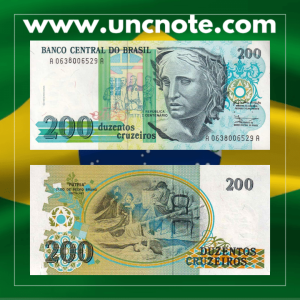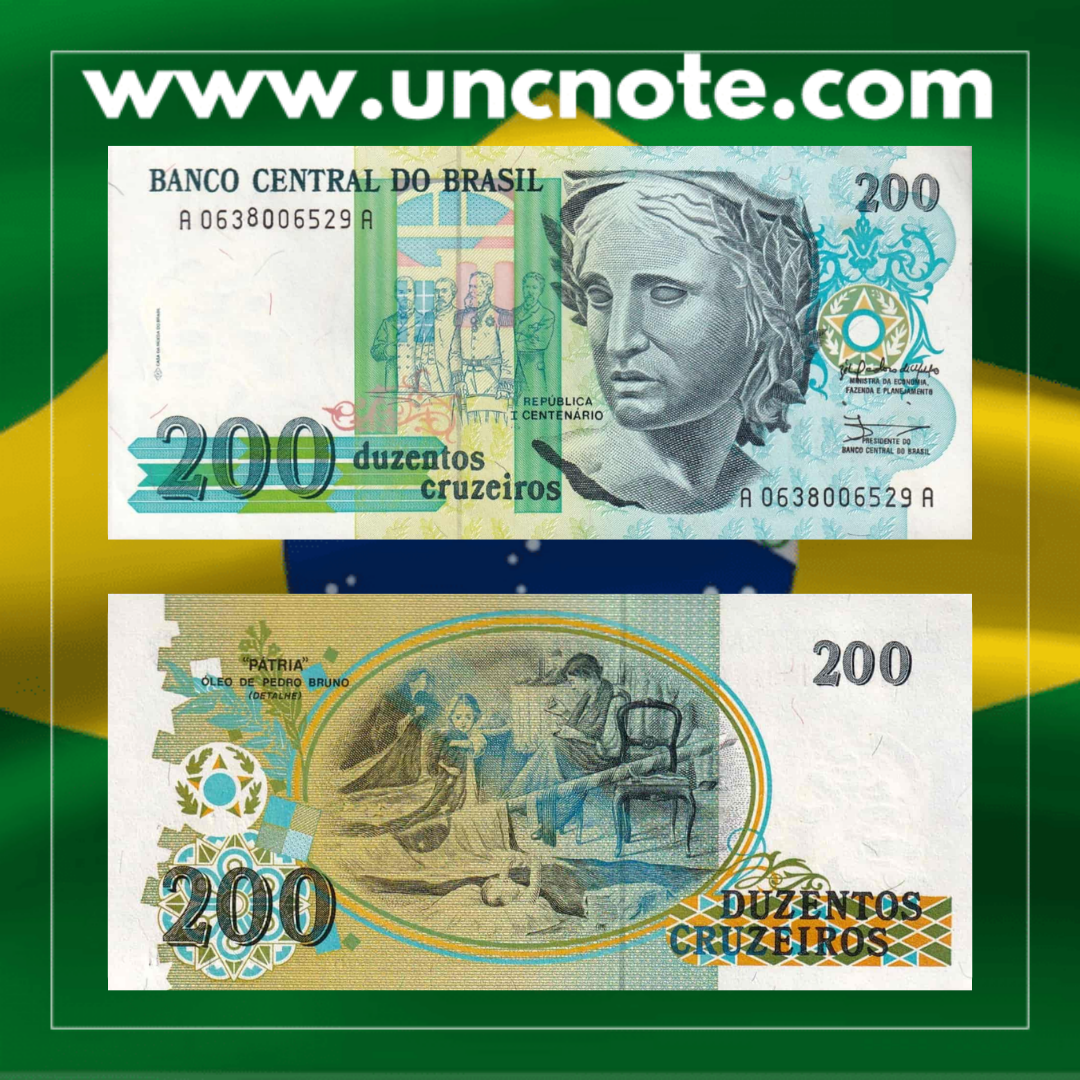
Brazil 200 Cruzeiros 1990 Pick 229 UNC Banknote
The Brazil 200 Cruzeiros 1990 Pick 229 is a striking banknote from one of the most turbulent periods in modern Brazilian monetary history.
Issued by the Banco Central do Brasil, the note combines two major national symbols. The obverse displays a classical female personification of the Brazilian Republic, while the reverse recalls the country’s independence from Portugal through the celebrated scene of Dom Pedro I’s proclamation of independence.
The note belongs to the Cruzeiro currency introduced in 1990, when the existing Cruzado Novo was renamed Cruzeiro at parity.
Historical Background
Brazil experienced extremely high inflation during the late 1980s and early 1990s, resulting in repeated currency reforms.
The Cruzado Novo, introduced in January 1989, survived for little more than a year. On 16 March 1990, the government replaced its name with Cruzeiro, without removing any additional zeros:
1 Cruzado Novo = 1 Cruzeiro
The 200 Cruzeiros P-229 belongs to this monetary period.
Inflation continued to accelerate, however, and the denomination quickly lost purchasing power. Brazil would introduce the Cruzeiro Real in 1993 before finally achieving greater monetary stability with the introduction of the Real in 1994.
Technical Specifications
- Country: Brazil
- Denomination: 200 Cruzeiros
- Year: ND (1990)
- Pick Number: P-229
- Condition: Uncirculated (UNC)
- Issuer: Banco Central do Brasil
- Currency: Brazilian Cruzeiro
- Material: Paper
- Dominant Colour: Green / blue-green and multicolour
- Obverse: Effigy of the Republic
- Reverse: Independence of Brazil
- Historical Figure: Dom Pedro I
- Type: Standard circulation banknote
- Status: Withdrawn currency
Obverse
The obverse features:
- Allegorical Effigy of the Republic
- Brazilian national symbols
- 200 Cruzeiros denomination
- Banco Central do Brasil inscription
- Serial numbers
- Elaborate geometric security patterns
- Multicoloured background elements
The female figure is an allegorical representation of the Republic, rather than a portrait of a specific historical person.
This type of classical republican imagery has a long history in Brazilian currency and official symbolism.
Reverse
The reverse depicts:
- Dom Pedro I
- Independence proclamation scene
- Mounted figures
- 200 Cruzeiros denomination
- Banco Central do Brasil inscriptions
- Detailed landscape and historical imagery
The composition is based on Pedro Américo’s famous painting Independência ou Morte!, also known as the Cry of Ipiranga.
It represents the traditional account of 7 September 1822, when Pedro proclaimed Brazil’s independence from Portugal near the Ipiranga River in São Paulo.
He subsequently became Pedro I, the first Emperor of Brazil.
The Cry of Ipiranga
According to Brazil’s traditional national narrative, Pedro received correspondence indicating that Portugal intended to restrict Brazil’s autonomy.
Near the Ipiranga River, he declared:
“Independência ou Morte!” — “Independence or Death!”
The event became one of the foundational scenes of Brazilian national history.
The dramatic representation used on the banknote derives from the monumental painting completed by Pedro Américo in 1888, decades after the actual event.
Why Add This Banknote to Your Collection?
The Brazil 200 Cruzeiros 1990 Pick 229 UNC banknote combines Brazil’s republican symbolism with one of the country’s most famous historical events.
It is particularly suitable for collectors of Brazilian banknotes, Latin American currency, independence themes, historical paintings on money, inflation-era currency and UNC world paper money.