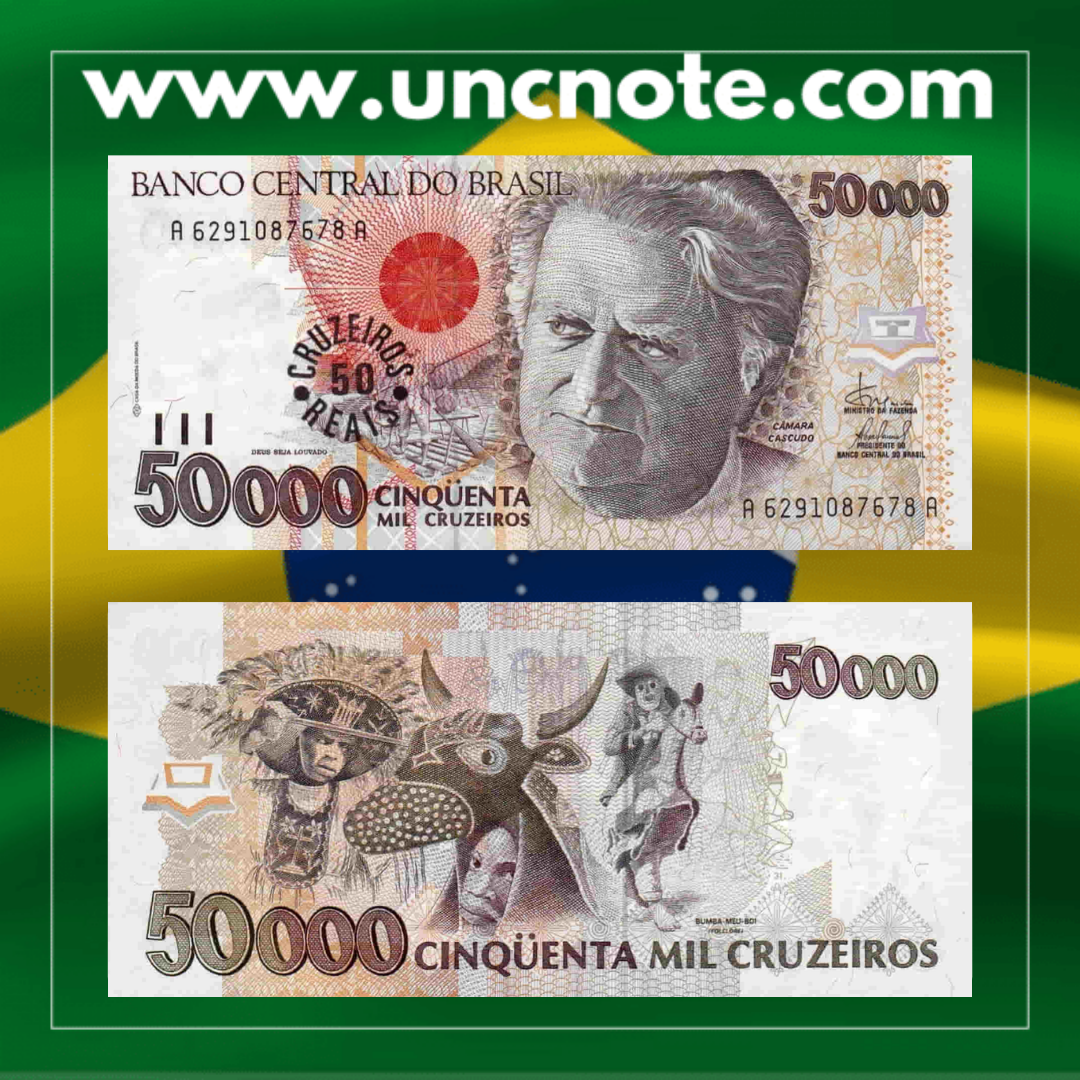
Brazil 50 Cruzeiros Reais on 50000 Cruzeiros ND (1993) Pick 237 UNC Banknote
The Brazil 50 Cruzeiros Reais 1993 Pick 237 is a striking transitional banknote from the final phase of Brazil’s long struggle with extreme inflation before the introduction of the Real.
Rather than immediately producing enough completely new banknotes for the new currency, the Banco Central do Brasil adapted existing 50,000 Cruzeiros notes by applying an overprint indicating their new value of 50 Cruzeiros Reais.
The conversion was straightforward:
50,000 Cruzeiros = 50 Cruzeiros Reais
This makes P-237 a particularly clear physical example of Brazil’s repeated redenominations during the early 1990s.
Historical Background
By 1993, Brazil was experiencing extremely high inflation. The Cruzeiro introduced in 1990 had rapidly lost purchasing power, forcing the government to undertake yet another monetary reform.
On 1 August 1993, the Cruzeiro Real (CR$) replaced the Cruzeiro at the rate:
1 Cruzeiro Real = 1,000 Cruzeiros
Existing notes could therefore be adapted simply by removing three zeros from their nominal value.
The 50,000 Cruzeiros consequently became 50 Cruzeiros Reais, resulting in the overprinted P-237 issue.
The Cruzeiro Real itself would prove extremely short-lived. It circulated for less than a year before Brazil introduced the Real (R$) on 1 July 1994.
Who Was Câmara Cascudo?
Luís da Câmara Cascudo (1898–1986) was a Brazilian historian, anthropologist, ethnographer, lawyer and writer.
Born in Natal, Rio Grande do Norte, he devoted much of his career to documenting Brazilian folklore, traditions, legends, food, customs and popular culture.
His enormous body of research made him one of Brazil’s most important scholars of folklore.
His best-known works include the monumental Dicionário do Folclore Brasileiro, an extensive reference work documenting Brazilian popular traditions.
This cultural legacy explains the rich folkloric imagery found throughout the original 50,000 Cruzeiros design.
Technical Specifications
- Country: Brazil
- New Denomination: 50 Cruzeiros Reais
- Original Denomination: 50,000 Cruzeiros
- Year: ND (1993)
- Pick Number: P-237
- Condition: Uncirculated (UNC)
- Issuer: Banco Central do Brasil
- Currency: Cruzeiro Real (BRR)
- Material: Paper
- Portrait: Luís da Câmara Cascudo
- Type: Overprinted circulation banknote
- Theme: Brazilian folklore and popular culture
- Conversion: 1 Cruzeiro Real = 1,000 Cruzeiros
- Status: Withdrawn currency
Obverse
The obverse features:
- Portrait of Luís da Câmara Cascudo
- 50 Cruzeiros Reais overprint
- Original 50,000 Cruzeiros denomination
- Banco Central do Brasil inscription
- Serial numbers
- Folkloric and cultural design elements
- Complex geometric security patterns
The most important characteristic for collectors is the visible interaction between the original 50,000 Cruzeiros design and the later overprint identifying its new monetary value.
Reverse
The reverse continues the tribute to Brazilian folklore and popular culture, reflecting Câmara Cascudo’s lifelong research.
Its imagery incorporates cultural and traditional motifs associated with the enormous diversity of Brazilian folklore.
This makes the banknote particularly attractive beyond its monetary history: it simultaneously documents a currency reform and celebrates an important scholar of Brazilian cultural traditions.
Why Was It Overprinted?
Brazil needed to introduce the Cruzeiro Real quickly while dealing with very high inflation.
Existing banknotes therefore provided an immediate source of currency during the transition.
Because exactly three zeros were removed, conversion was simple:
10,000 Cruzeiros → 10 Cruzeiros Reais
50,000 Cruzeiros → 50 Cruzeiros Reais
100,000 Cruzeiros → 100 Cruzeiros Reais
Overprinting allowed these existing notes to circulate under the new monetary system while dedicated Cruzeiro Real banknotes were introduced.
Why Add This Banknote to Your Collection?
The Brazil 50 Cruzeiros Reais on 50000 Cruzeiros 1993 Pick 237 UNC banknote is particularly interesting because the redenomination remains physically visible on the note itself.
It is ideal for collectors of Brazilian banknotes, overprinted currency, inflation notes, monetary reforms, Latin American currency, folklore themes and historical UNC world paper money.