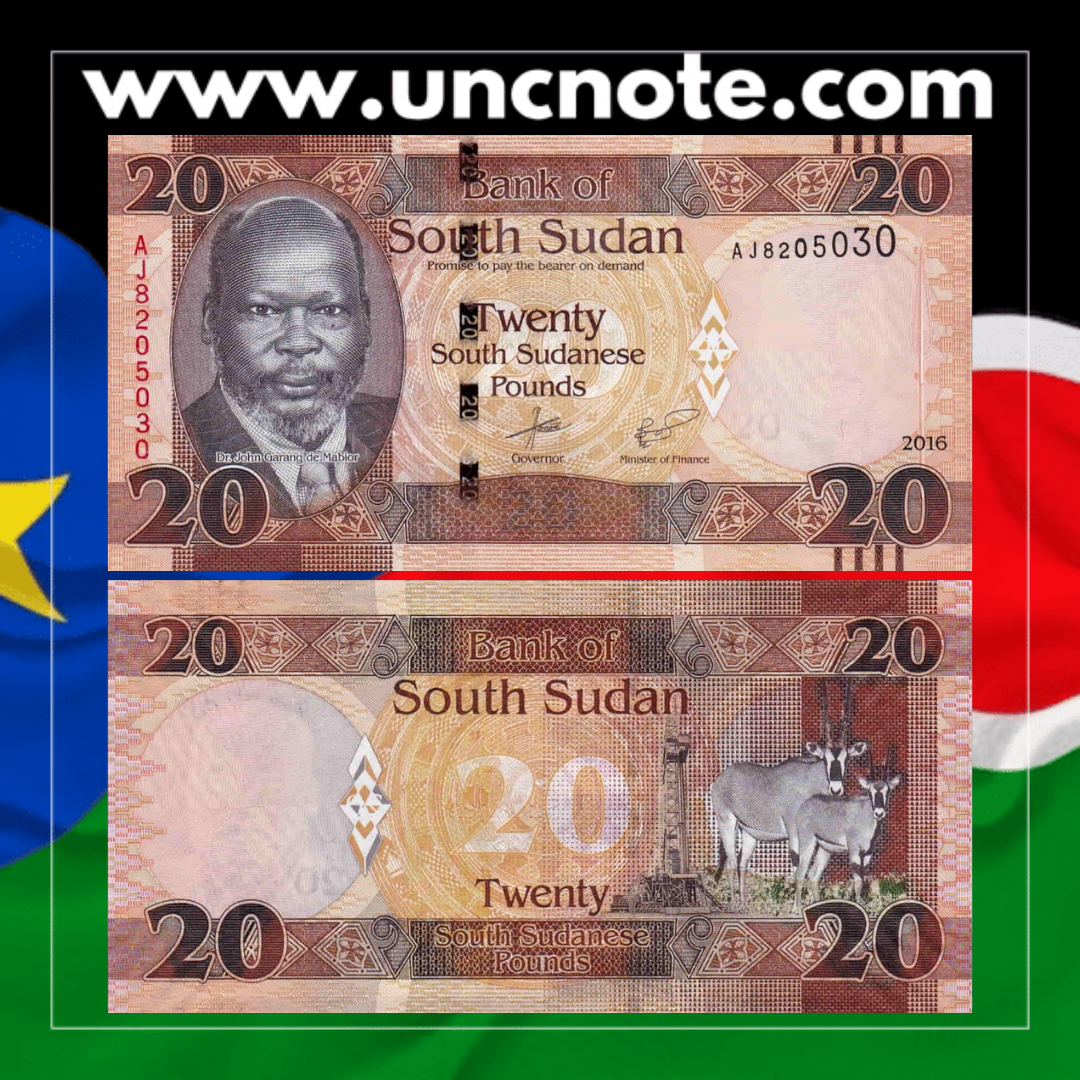
South Sudan 20 Pounds 2016 Pick 13b UNC Banknote
The South Sudan 20 Pounds 2016 Pick 13b is a modern African banknote issued by the Bank of South Sudan, the central bank of the Republic of South Sudan.
Featuring the portrait of Dr. John Garang de Mabior (1945–2005), the banknote commemorates one of the most influential political figures in the country’s history.
South Sudan became independent on 9 July 2011, following decades of conflict and negotiations with Sudan. Shortly afterwards, the country introduced its own national currency, the South Sudanese Pound.
The 20 Pounds denomination belongs to this early period of independent monetary history.
Dating from 2016, the banknote represents a time when South Sudan was establishing its national institutions while facing significant political and economic challenges.
Preserved in uncirculated condition, this historical issue is an attractive addition to collections of African paper money and contemporary world currencies.
Historical Background
South Sudan’s modern history is closely connected with the political developments that shaped Sudan during the twentieth and early twenty-first centuries.
Following decades of civil conflict, the Comprehensive Peace Agreement was signed in January 2005.
The agreement established a framework for peace and provided for a referendum on self-determination.
In January 2011, the population of Southern Sudan voted overwhelmingly in favour of independence.
On 9 July 2011, the Republic of South Sudan officially became an independent nation.
The introduction of a separate national currency was one of the most important steps in establishing the country’s economic sovereignty.
The South Sudanese Pound (SSP) was introduced on 18 July 2011, replacing the Sudanese Pound.
The 20 Pounds 2016 banknote belongs to the first decade of this new monetary system.
Banknote Specifications
| Feature | Details |
|---|---|
| Country | South Sudan |
| Issuing authority | Bank of South Sudan |
| Denomination | 20 Pounds |
| Year | 2016 |
| Catalogue reference supplied | Pick 13b |
| Currency | South Sudanese Pound (SSP) |
| Condition | Uncirculated (UNC) |
| Material | Paper |
| Type | Circulation banknote |
| Main portrait | Dr. John Garang de Mabior |
| Currency introduced | 2011 |
| Region | East Africa |
Obverse
The obverse features a portrait of Dr. John Garang de Mabior, one of the most important figures in South Sudan’s modern political history.
Garang was the founder and leader of the Sudan People’s Liberation Movement (SPLM) and played a central role in negotiations that led to the Comprehensive Peace Agreement of 2005.
His portrait was selected for South Sudanese banknotes to recognise his contribution to the country’s struggle for self-determination.
The design also incorporates the denomination of 20 South Sudanese Pounds, official inscriptions and security elements.
The precise signatures, security features and catalogue characteristics of the Pick 13b variety should be verified against the physical banknote.
Reverse
The reverse of the South Sudanese 20 Pounds banknote features imagery associated with the country’s natural environment and wildlife heritage.
South Sudan is home to extensive grasslands, savannas and wetlands, supporting a wide variety of African wildlife.
The country’s banknotes use natural and cultural imagery to represent its identity as an independent nation.
The exact reverse motif of the 2016 Pick 13b variety should be confirmed against the physical specimen before publication.
John Garang de Mabior (1945–2005)
John Garang de Mabior was born on 23 June 1945 in what is now South Sudan.
He became a military officer, political leader and one of the most influential figures in the country’s independence movement.
Garang founded and led the Sudan People’s Liberation Movement and Army (SPLM/A) during the Second Sudanese Civil War.
He played a central role in negotiations that resulted in the Comprehensive Peace Agreement, signed on 9 January 2005.
Following the agreement, Garang became First Vice President of Sudan and President of the autonomous Government of Southern Sudan.
However, he died in a helicopter crash on 30 July 2005, several years before South Sudan achieved independence.
Although Garang did not live to see the establishment of the independent republic, his political legacy remains closely associated with the country’s national identity.
His portrait appears on numerous South Sudanese banknotes, making him one of the most recognisable figures in the country’s currency designs.
South Sudan’s Independence in 2011
South Sudan officially became independent on 9 July 2011, following a referendum held earlier that year.
The country was admitted to the United Nations on 14 July 2011, becoming its 193rd member state.
Independence marked the culmination of decades of political negotiations and armed conflict.
The establishment of a national currency was an important part of creating the institutions of the new republic.
The South Sudanese Pound was introduced only nine days after independence.
Banknotes featuring John Garang became a symbol of the country’s new political and monetary identity.
The South Sudanese Pound
The South Sudanese Pound (SSP) is the official currency of South Sudan.
It was introduced on 18 July 2011, replacing the Sudanese Pound during the transition to independence.
One South Sudanese Pound is divided into 100 Piastres.
The currency is issued by the Bank of South Sudan.
| Year | Monetary development |
|---|---|
| 2011 | South Sudan becomes independent |
| 2011 | South Sudanese Pound introduced |
| 2013 | Beginning of the South Sudanese Civil War |
| 2016 | Year of the 20 Pounds issue offered here |
| 2018 | Revitalised peace agreement signed |
| 2021 | Introduction of a 1000 Pounds banknote |
South Sudanese banknotes are particularly interesting because they document the early monetary history of a country established in the twenty-first century.
The Bank of South Sudan
The Bank of South Sudan is the central bank of the Republic of South Sudan.
Established following independence in 2011, the institution is responsible for issuing the national currency, implementing monetary policy and overseeing the banking system.
One of its earliest responsibilities was the introduction of the South Sudanese Pound.
The country’s banknotes feature historical portraits, cultural imagery and natural subjects representing South Sudan’s identity.
The 20 Pounds denomination forms part of this national currency tradition.
South Sudan in 2016
The year 2016 was an important and difficult period in South Sudan’s modern history.
The country was experiencing the effects of the civil war that had begun in December 2013.
Despite the signing of a peace agreement in August 2015, political tensions and violence continued.
In July 2016, renewed fighting broke out in the capital, Juba, contributing to further instability and displacement.
The country’s economy also faced significant challenges, including inflation, currency depreciation and disruption to trade.
The 20 Pounds 2016 banknote provides collectors with a tangible connection to this period in South Sudan’s early history as an independent nation.
South Sudan’s Natural Heritage
South Sudan contains extensive natural habitats, including savannas, grasslands, forests and wetlands.
One of its most important geographical features is the Sudd, a vast wetland associated with the White Nile.
The Sudd supports numerous bird species and provides important habitats for wildlife.
South Sudan is also known for large seasonal migrations of antelopes across its grasslands.
The country’s natural environment plays an important role in its national identity and is reflected in its banknote designs.
Collecting South Sudanese Banknotes
South Sudan is an interesting collecting area because its national currency was introduced only in 2011.
Its banknotes provide examples of the monetary system of one of the world’s newest independent nations.
Collectors can organise South Sudanese paper money by denomination, issue year, catalogue reference or design variety.
The 20 Pounds Pick 13b can complement other denominations featuring John Garang, including the 100 Pounds 2019 Pick 15d.
Together, these banknotes illustrate the development of South Sudan’s national currency during its first decade of independence.
Why Add This Banknote to Your Collection?
The South Sudan 20 Pounds 2016 Pick 13b UNC Banknote offers several attractive collecting features:
-
John Garang portrait: honours an influential figure in South Sudan’s independence movement.
-
Young independent nation: represents the national currency introduced in 2011.
-
2016 issue: associated with the country’s early years of statehood.
-
Historical significance: reflects a period of major political and economic developments.
-
Uncirculated condition: preserved without normal circulation wear.
-
African numismatics: an attractive addition to collections of East African banknotes.
-
Modern monetary history: complements other South Sudanese Pound denominations.